


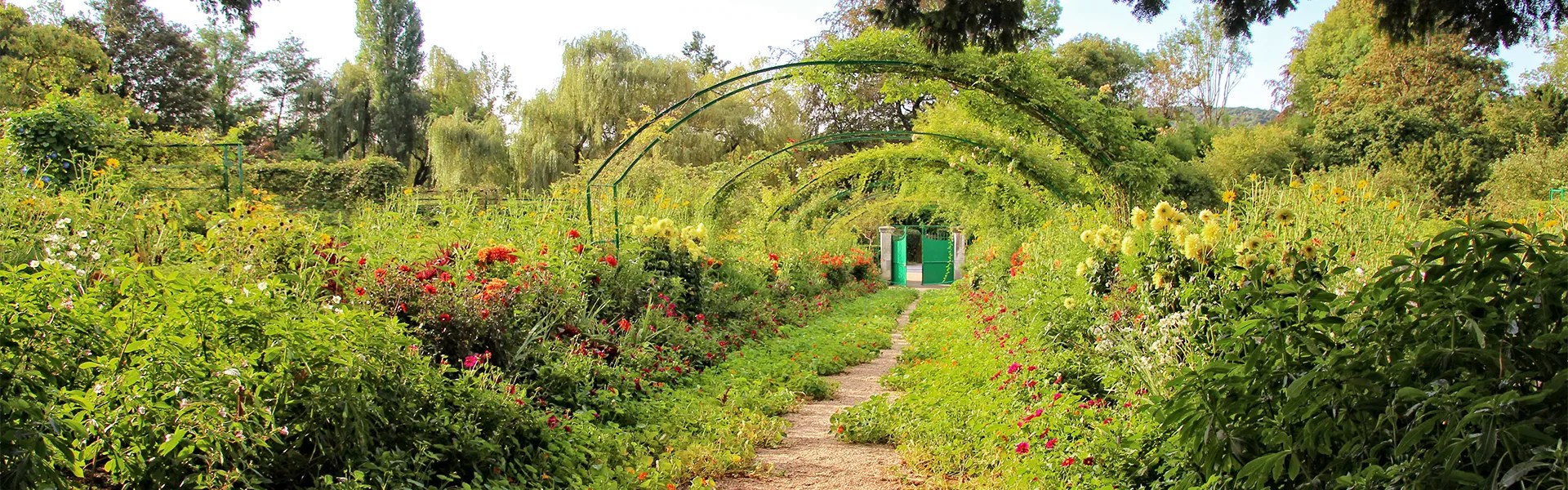

As Normandy and the Paris area commemorate the Monet Centenary 2026, uncover 10 enjoyable details about Monet together with his love of quick vehicles!
One of many world’s best-loved artists, Impressionist painter Claude Monet died on 5 December 1926 on the age of 86. Well-known for his skilful evocation of sunshine and color, Monet is buried within the churchyard at Giverny in Normandy, a brief stroll from the home the place he spent the second half of his life.
Monet grew up in Normandy at Le Havre, shifting to Paris within the 1860s to additional his inventive profession, and this yr greater than 100 centenary occasions and exhibitions will likely be happening throughout Normandy and the Paris Area to mark his legacy. Monet’s distinctive type is immediately recognisable, however how a lot do you actually know concerning the man who spearheaded an inventive revolution…?
Monet was simply 32 when he unwittingly launched Impressionism
In Paris, Monet met different younger painters eager to rock the established artwork world with a brand new type of artwork that concerned portray outdoor, and in 1874, he exhibited a now iconic portray at their first ground-breaking exhibition. ‘Impression, soleil levant’ was an atmospheric research of dawn over the port of Le Havre, disdainfully dubbed Impressionism by one critic. However the title caught, and the motion progressively gathered momentum.

Claude Monet was inspired by Honfleur artist Eugène Boudin
Recognized for his evocative seascapes, large skies and seaside scenes, Eugène Boudin lived in Honfleur, throughout the Seine estuary from in Le Havre. He recognised the younger artist’s expertise and opened his eyes to the limitless potentialities of portray ‘en plein air’. Claude was later to comment that he ‘owed all the pieces’ to Boudin.
City scenes may encourage Monet as a lot because the pure world
For Monet, portray was all about gentle and environment, the colors and patterns that modified with climate and time of day. However not solely within the countryside. That well-known research of Le Havre depicts the hazy outlines of cranes and chimneys on the quayside and even when residing in Normandy, Monet spent common durations in Paris. He beloved capturing the modernity of the capital in scenes such because the steam trains at Gare Saint-Lazare, his smoky skies so life like you may nearly odor them. He additionally labored in London, finishing evocative research of Westminster and the River Thames.
Giverny was not Monet’s solely dwelling within the Seine valley
As a younger, hard-up artist, Monet moved regularly round Paris, usually to flee collectors, however progressively he was in a position to transfer west alongside the Seine. His home and backyard at Giverny, the place he lived for greater than 40 years from 1883 are the second most visited attraction in Normandy. However Monet’s two earlier properties are additionally now open to guests at Argenteuil (1874 to 1878) and Vétheuil (1878 to 1881).
Monet married twice
He married his favorite mannequin Camille Doncieux (she options in 50 of Monet’s work) in 1870, three years after the delivery of their son Jean, their second son Michel was born in 1878. Camille tragically died at their dwelling in Vétheuil aged simply 32. His second spouse Alice was first married to artwork collector and division retailer magnate Ernest Hoschedé, who commissioned a number of works from Monet – together with ‘Impression, soleil levan.’’ Alice and Claude married in 1892 after Ernest’s dying, residing at Giverny together with her six youngsters and his two sons. Alice’s daughter Blanche turned Monet’s pupil and married his son (additionally her stepbrother) Jean.

Gardening was a ardour earlier than Monet moved to Giverny
Monet’s backyard at Vétheuil options in a lot of his work and when he moved to Giverny, Monet quickly started organising a serious transformation, enlarging the pond, and filling it with water lilies. He wrote day by day directions to a crew of seven gardeners concerning the design, planting layouts and buying of recent crops to create a backyard that was like a residing paint palette, offering him with an limitless supply of inventive inspiration.

Monet beloved good meals, vehicles and Japanese prints
Mealtimes at Giverny had been sacrosanct, beginning at 6am with a breakfast that included andouillette (tripe sausage) and white wine within the vivid yellow eating room. And he was fascinated by vehicles, typically driving 200km to Lamotte-Beuvron for an apple tart made by the Tatin sisters! He was additionally a passionate collector of Japanese prints.

Monet by no means bored with the identical view
Captivated by the consequences of various lights on a single topic, from the Eighteen Nineties onwards Monet labored nearly solely on sequence of work corresponding to Meules (haystacks) and Peupliers (Poplars), recording the nuances of sunshine underneath various circumstances. He pictured the façade of Rouen Cathedral greater than 30 occasions, sitting in an upstairs room above what’s now the Rouen Vacationer Workplace.
Monet was his personal harshest critic
He as soon as wrote “My life has been nothing however a failure, and all that’s left for me to do is to destroy my work earlier than I disappear,” and his spouse Alice wrote to a buddy in 1908 that “he punctures canvases every single day.” In 1907, a present of his work in Paris needed to be postponed after he took a knife to a minimum of 15 of his water lily work. It’s estimated he destroyed as many as 500 work.
The immersive water lily expertise on the Orangerie in Paris was Monet’s thought
Monet was obsessed together with his water lilies. He instructed his gardeners to scrub and mud every lily pad, and he captured their magnificence in additional than 250 canvases. Instantly after the Armistice was signed on the finish of World Struggle I, Monet wrote to his buddy Georges Clemenceau, Prime Minister of France, providing two big water lily panels to the nation. This was the beginning of the magnificent show on the Museée de l’Orangerie, which Monet labored on throughout his final years, specifying precisely how the panels ought to be hung to position the viewer on the centre of the pond.
He died the yr earlier than the museum opened in 1927. By then, Impressionism had fallen out of style, public curiosity was restricted, and it was not till after the Second World Struggle that Monet and his fellow Impressionists had been in vogue as soon as once more. They’ve remained in style ever since.
Main Monet collections in France
In Normandy, the Fantastic Arts Museum in Rouen is dwelling to the most important Impressionist assortment outdoors Paris (entry is free), and in Le Havre, the André Malraux Museum of Trendy Artwork – MuMa – will stage a centenary exhibition, ‘Monet in Le Havre’, from 5 June to 27 September.
In Paris, see masterpieces by Monet on the Musée Marmottan Monet and on the Musée d’Orsay, dwelling to the world’s largest assortment of Impression portray.
Impressionism for our occasions
The Impressionists had been modern in each their material and strategies, taking collective motion to create an artists’ cooperative. In 2010, an thought emerged in Normandy to construct an occasion to have a good time the area by showcasing its Impressionist heritage alongside the modern artwork scene.
The fifth Normandie Impressioniste occasion in 2024 recorded over two million visits by means of a multidisciplinary programme of artwork and tradition. In 2026, for the primary time in its historical past, the competition is completely devoted to modern artwork. Vital artists from France and the world over have been invited to create an unique tribute to Monet primarily based across the theme of the backyard: normandie-impressionniste.fr/en
Following the Seine from Le Havre by means of Honfleur, Rouen and Vernon to Paris, Normandie Impressioniste 2026 will function work and images, videography and even firework shows in public gardens and museums, in church buildings and on riverbanks. Monet, one feels, would have been thrilled.
Need extra France?
Uncover extra fabulous locations in France with our free journal The Good Life France
Love France? Have a hearken to our podcast – all the pieces you need to learn about France and extra!
All rights reserved. This text might not be printed, broadcast, rewritten (together with translated) or redistributed with out written permission

