


AI is accelerating the creation of enterprise content material and elevating the stakes for a way that content material is discovered, shared, and put to work. Each proposal, evaluation, and venture plan attracts on data a enterprise already holds and creates new information for others to make use of. As content material volumes develop, time spent gathering context, finding the fitting model, and transferring helpful output between instruments can add up throughout groups. Our analysis explores how AI is altering content material at work, the place that friction is constructing, and what it means for companies aiming to show sooner creation into lasting productiveness.
Dropbox surveyed 219 professionals primarily working in expertise, AI, software program, finance, and healthcare at The AI Convention 2026 in San Francisco. This report brings collectively 70+ statistics from our newest market analysis on how AI is altering content material at work—from time spent gathering context to the expansion in content material creation and the place helpful AI-generated work is saved and shared.
Key report findings
- 15.8 hours per week averaged partaking with AI at work
- 36.6% of AI engagement time is spent unproductively retrieving context
- 4.3 further context inputs required after the primary immediate
- 46.4% of the brand new work recordsdata are developed with AI
- 162.6% common progress in new work recordsdata created since AI adoption
- 93.2% of individuals create extra work recordsdata now with AI
- 43.8% of helpful outcomes created by AI by no means depart the immediate
AI is turning into a considerable a part of the workweek, and the amount of content material folks create is rising with it. Gathering context is a significant supply of friction, with folks repeatedly including recordsdata, hyperlinks, and background earlier than a consequence is able to use. Helpful output then spreads throughout shared workspaces, native recordsdata, and chats, leaving groups with a rising physique of information to prepare, share, and put to work.
We spend 15.8 hours per week at work actively partaking with AI
What does your common workweek seem like now in contrast with three years in the past? Whereas many professionals beforehand misplaced many hours to routine jobs reviewing, writing, researching, or creating precise code, plenty of this work is delegated to AI nowadays. However with AI optimizing so many areas of labor, how a lot time do we have now to spend money on actively managing our AI?
The common particular person spends 15.8 hours every week actively partaking with AI at work alone—and that is exterior of auto-running Codex jobs that function on autopilot. However much more telling, solely 2.3% of individuals report zero time with AI on a median week.
Right here’s what folks report for AI engagement time on a median week:
- 2.3% spend 0 hours at work partaking AI
- 16.4% spend 1–5 hours at work partaking AI
- 24.7% spend 6–10 hours at work partaking AI
- 7.8% spend 11–15 hours at work partaking AI
- 16.4% spend 16–20 hours at work partaking AI
- 6.4% spend 21–25 hours at work partaking AI
- 5.0% spend 26–30 hours at work partaking AI
- 21.0% spend 30 or extra hours at work partaking AI
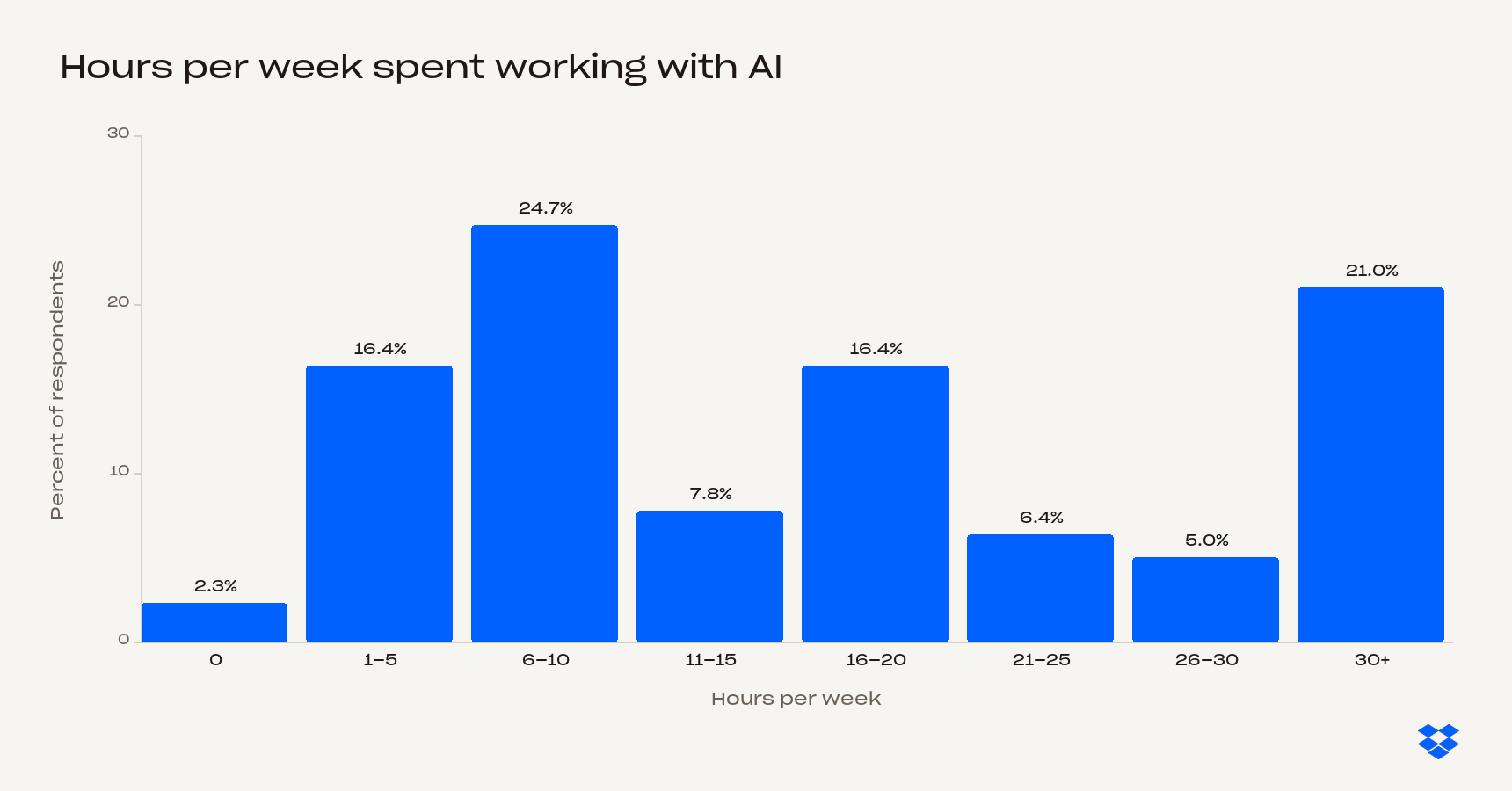
81.3% of respondents spend not less than six hours every week actively working with AI, and almost half—48.8%—spend greater than 15 hours. The biggest group reviews 6–10 hours, whereas roughly one in 5 reviews 30 or extra, exhibiting how broadly the extent of engagement varies.
For this group of pros, AI already occupies a considerable a part of the workweek. With that a lot time invested, the trouble required to seek out data, provide context, and refine outcomes issues to total productiveness.
36.6% of AI time is spent retrieving context
Getting AI the data it wants takes substantial time. Respondents estimate that 36.6% of their AI engagement time goes to discovering, opening, importing, or cross-referencing paperwork, messages, hyperlinks, and knowledge in different work apps. Utilized to a 15.8-hour AI workweek, that represents roughly 5.8 hours every week spent retrieving context—time diverted from creating, refining, and finishing the work itself.
Right here’s how context retrieval time value breaks down throughout the board:
- 1.8% spend 0% of AI time retrieving context
- 10.5% spend 10% of AI time retrieving context
- 22.8% spend 20% of AI time retrieving context
- 21.0% spend 30% of AI time retrieving context
- 12.3% spend 40% of AI time retrieving context
- 14.2% spend 50% of AI time retrieving context
- 5.9% spend 60% of AI time retrieving context
- 6.4% spend 70% of AI time retrieving context
- 0.0% spend 80% of AI time retrieving context
- 3.7% spend 90% of AI time retrieving context
- 1.4% spend 100% of AI time retrieving context
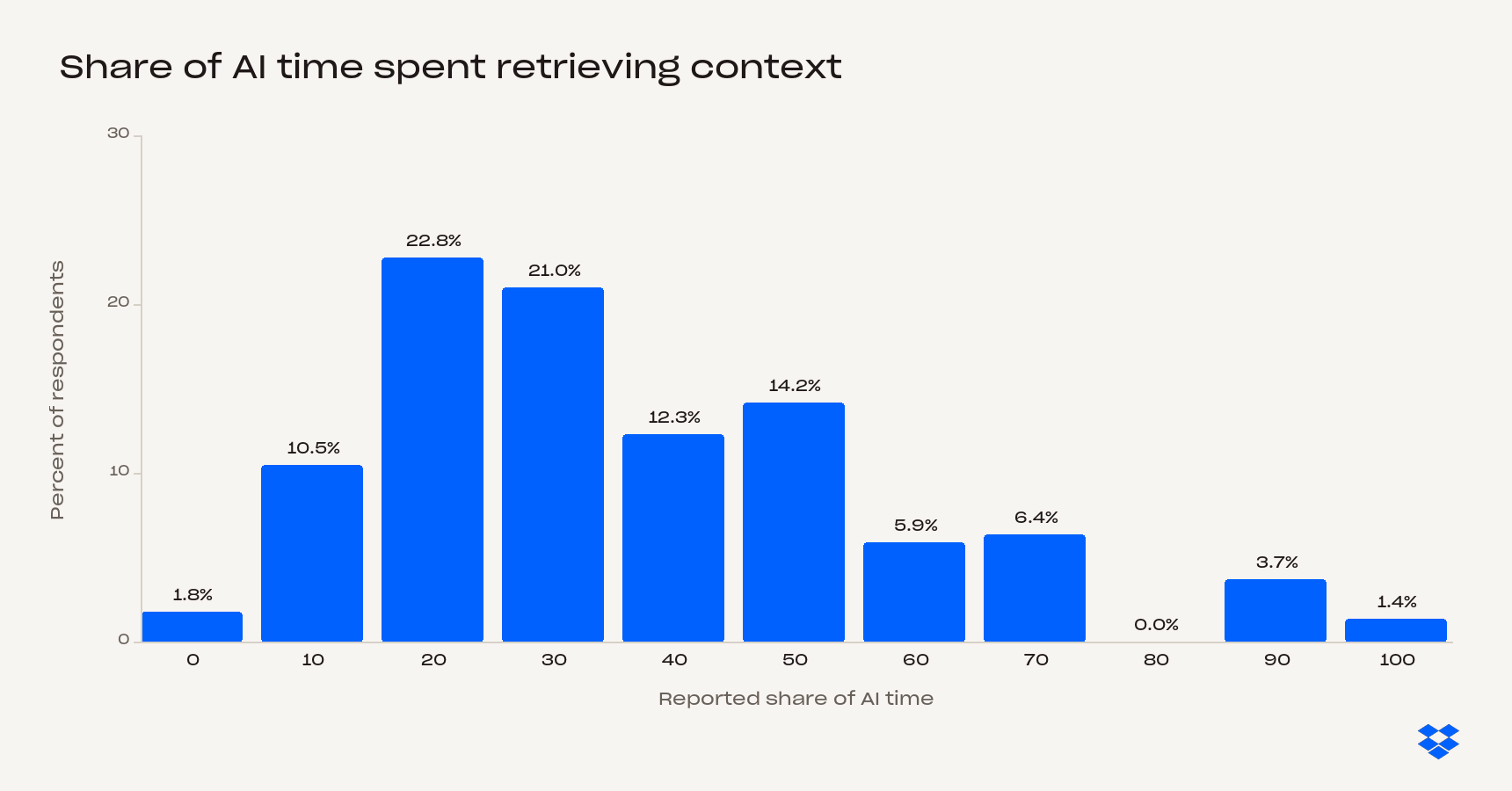
Practically one in three respondents spend not less than half of their AI time retrieving context, whereas simply 1.8% report spending none. Gathering data is a recurring a part of the AI workflow, and for a lot of, it consumes a considerable share of that point.
For companies, this factors to a sensible alternative to enhance AI productiveness: Make related content material simpler to seek out and convey into the workflow. Decreasing that effort might give staff extra time to develop helpful outcomes and transfer tasks ahead.
Context retrieval prices for companies
Hours spent gathering context add up shortly throughout a enterprise. Making use of the survey averages to all staff in a 100-person firm suggests roughly 27,691 hours a yr spent retrieving context—time valued at $1.15 million in salaries alone.
Decreasing that point by 50% by way of linked context and content material throughout the enterprise might get well roughly 13,846 hours yearly, representing $576,952 in potential productiveness financial savings. For a 1,000-person firm, that chance grows to $5.77 million a yr.
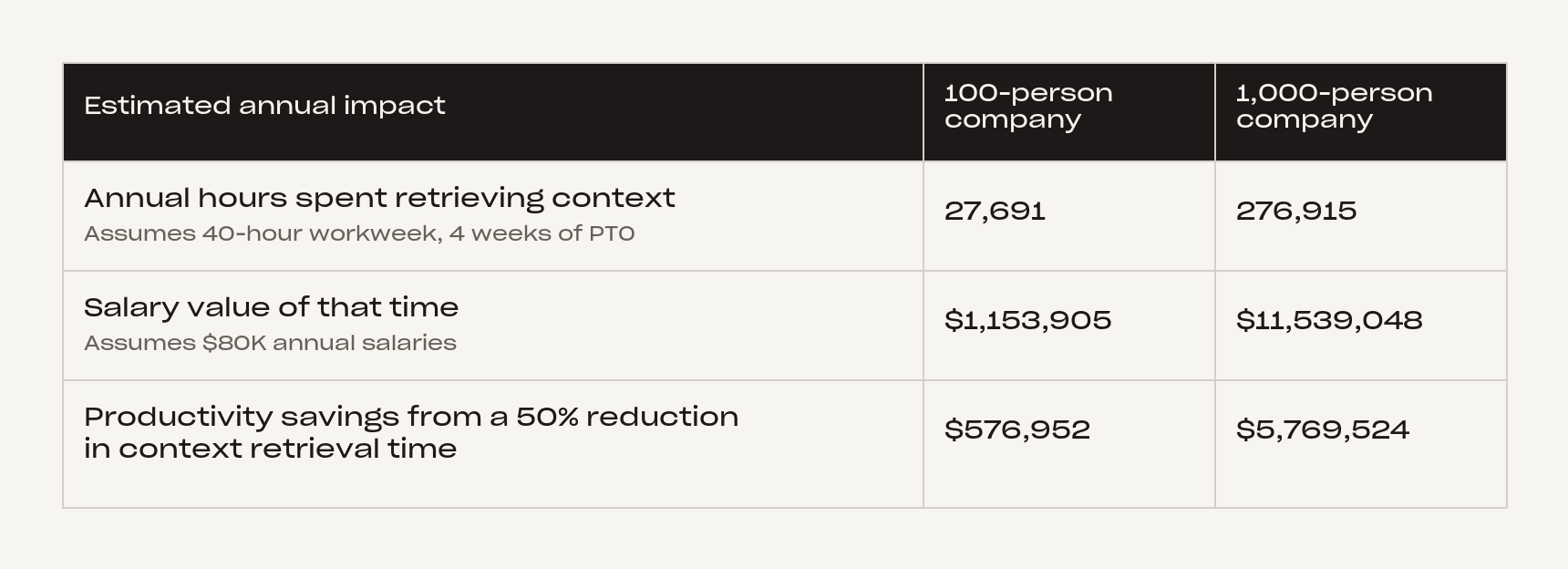
Making related content material simpler to seek out and use might liberate helpful time for groups. Even a partial discount in context retrieval creates time that companies can reinvest in buyer work, venture supply, and new initiatives.
We common 4.3 further context rounds after the primary immediate
What does this context retrieval seem like in apply? It continues properly past the primary immediate. Folks manually add new recordsdata, reference hyperlinks, examples, and background data to assist AI produce the consequence they want. Every spherical can require stepping away from the dialog, looking throughout different instruments, and bringing that data again into the duty.
Respondents report a median of 4.3 further context rounds earlier than a consequence is able to use. That repeated effort provides to the time spent gathering data and places extra accountability on the person to establish what AI wants.
The implications additionally prolong to high quality. When AI lacks related workforce and enterprise data, customers should acknowledge these gaps and fill them manually. Lacking a key determination, requirement, or supply doc can depart the consequence incomplete or inaccurate, making a threat of additional revisions and rework.
Right here’s how typically respondents add context throughout a typical AI activity:
- 4.1% want no further AI context inputs
- 12.3% want 1 further AI context inputs
- 21.0% want 2 further AI context inputs
- 14.2% want 3 further AI context inputs
- 11.0% want 4 further AI context inputs
- 15.1% want 5 further AI context inputs
- 4.6% want 6 further AI context inputs
- 2.7% want 7 further AI context inputs
- 1.8% want 8 further AI context inputs
- 3.2% want 9 further AI context inputs
- 3.2% want 10 further AI context inputs
- 0.9% want 11 further AI context inputs
- 2.3% want 12 further AI context inputs
- 0.9% want 13 further AI context inputs
- 0.5% want 14 further AI context inputs
- 2.3% want 15 or extra further AI context inputs
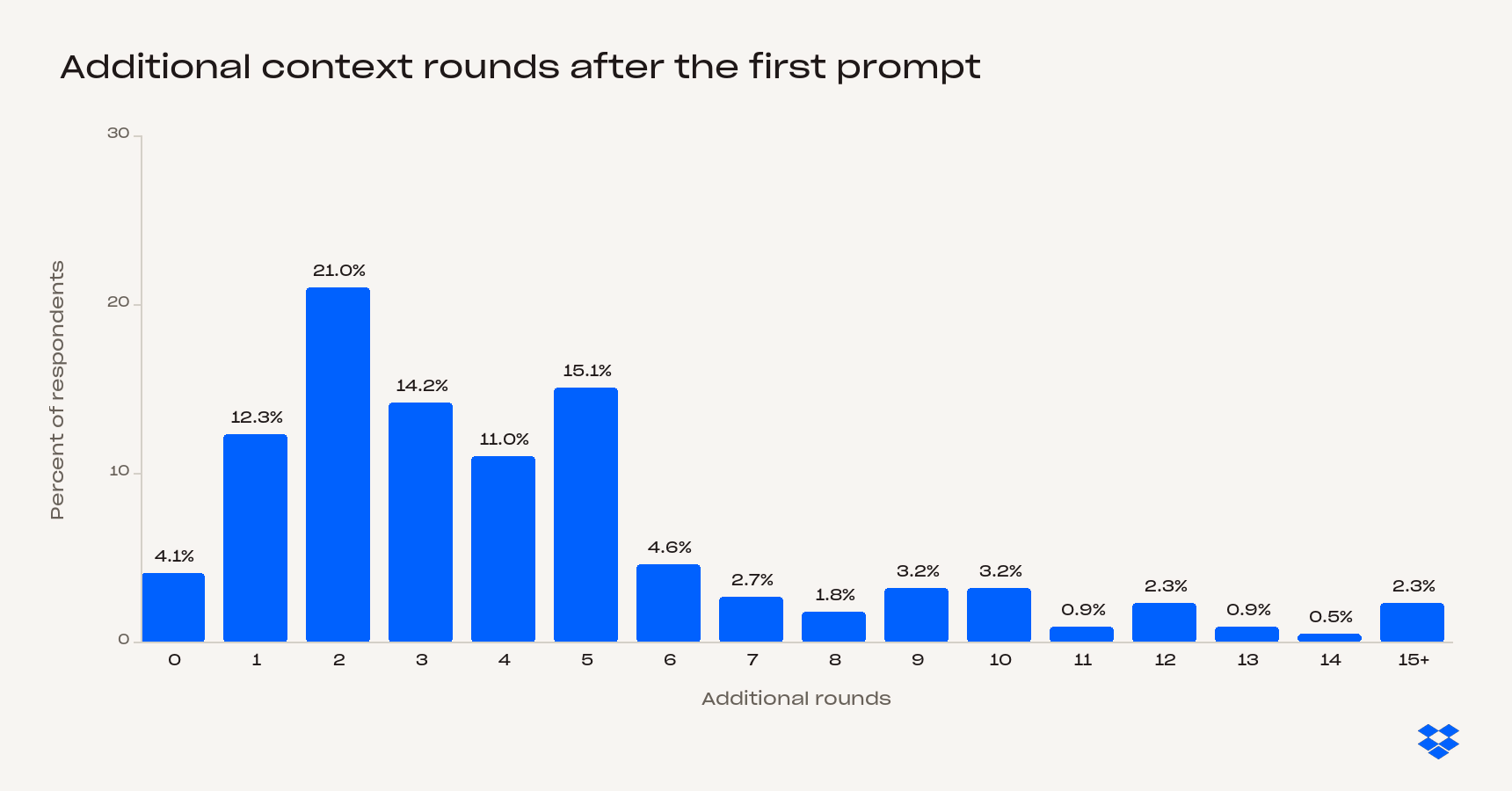
37.4% of respondents add context 5 or extra instances after the primary immediate, and 10.0% add it not less than 10 instances earlier than the consequence is able to use. For these professionals, including context occurs repeatedly all through a activity.
For companies, this helps clarify how context retrieval can devour a lot AI time. The trouble builds up throughout repeated searches and additions. Making related enterprise data simpler to carry into the workflow might scale back that burden and assist staff attain a usable consequence with fewer interruptions.
46.4% of recent work recordsdata are made with AI
AI helps create the recordsdata that transfer on a regular basis enterprise ahead. Gross sales groups use it to draft buyer proposals, analysts to show analysis into reviews or shows, and builders to jot down and revise code that used to take weeks to supply. However past new asset technology, AI additionally helps reshape present supplies—increasing a draft, incorporating new data, or adapting content material for a unique viewers.
That contribution now represents a considerable share of weekly output. On common, respondents estimate that 46.4% of the brand new work recordsdata they create or save are created or considerably modified with AI. Practically half of their new recordsdata carry AI’s affect into the work their groups assessment, share, and construct on.
Right here’s the share of recent work recordsdata respondents say AI creates or considerably modifications:
- 2.3% report 0% of recent recordsdata are made with AI
- 9.1% report 10% of recent recordsdata are made with AI
- 14.2% report 20% of recent recordsdata are made with AI
- 8.2% report 30% of recent recordsdata are made with AI
- 12.8% report 40% of recent recordsdata are made with AI
- 18.7% report 50% of recent recordsdata are made with AI
- 13.2% report 60% of recent recordsdata are made with AI
- 8.7% report 70% of recent recordsdata are made with AI
- 0.0% report 80% of recent recordsdata are made with AI
- 5.9% report 90% of recent recordsdata are made with AI
- 6.4% report 100% of recent recordsdata are made with AI
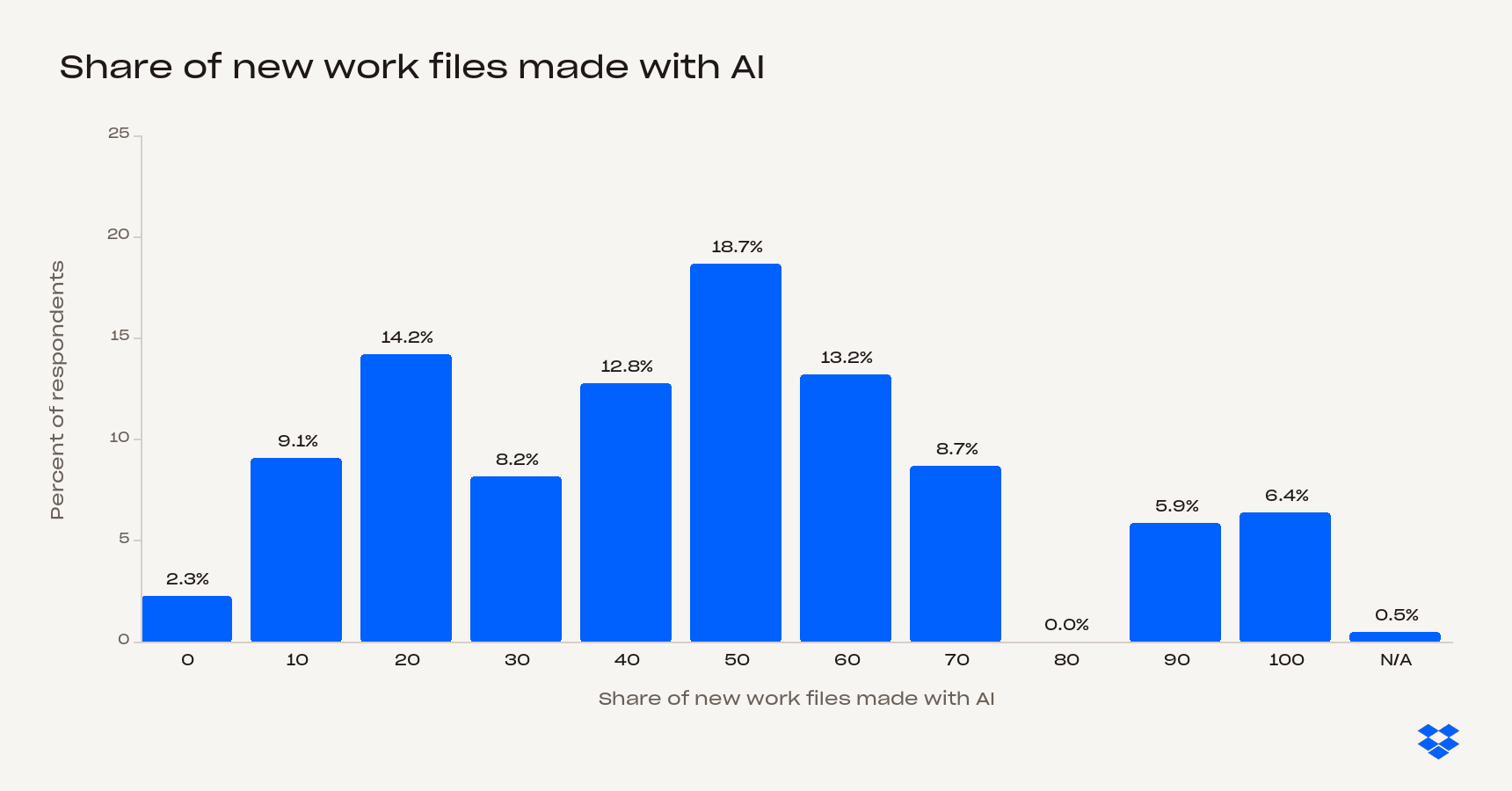
53.0% of respondents say AI creates or considerably modifications not less than half their new work recordsdata, whereas 12.3% put that share at 90% or extra. The biggest single group reviews a 50% share, exhibiting how a lot AI impacts on a regular basis content material creation.
For companies, this highlights the significance of managing AI-assisted work past the dialog the place it begins. As this content material turns into a part of each day operations, groups must assessment it, retain related context, and make it accessible for colleagues to make use of and construct on.
New work-file quantity is up 162.6% on common
AI can increase how a lot materials groups produce from a single activity. Analysis can grow to be a report, a presentation, and a briefing doc. A marketing campaign can generate a number of drafts and variations for various audiences. A venture can produce plans, updates, and supporting documentation. As that work is created and saved, the amount of recordsdata companies must handle can develop shortly.
In contrast with earlier than they frequently used AI, respondents report creating or saving a median of 162.6% extra new work recordsdata than earlier than they frequently used AI. Total, 93.2% report a rise, whereas 3.2% report no change and three.7% report a decline.
Right here’s how respondents describe the change of their new work-file quantity:
- 5.0% elevated recordsdata 1,000% or extra with AI
- 1.4% elevated recordsdata 500% with AI
- 1.8% elevated recordsdata 400% with AI
- 6.4% elevated recordsdata 300% with AI
- 8.7% elevated recordsdata 200% with AI
- 26.9% elevated recordsdata 100% with AI
- 2.7% elevated recordsdata 90% with AI
- 5.9% elevated recordsdata 80% with AI
- 6.8% elevated recordsdata 70% with AI
- 3.2% elevated recordsdata 60% with AI
- 11.9% elevated recordsdata 50% with AI
- 3.2% elevated recordsdata 40% with AI
- 5.9% elevated recordsdata 30% with AI
- 1.8% elevated recordsdata 20% with AI
- 1.4% elevated recordsdata 10% with AI
- 3.2% noticed no change in recordsdata with AI
- 0.5% decreased recordsdata 10% with AI
- 1.4% decreased recordsdata 20% with AI
- 0.0% decreased recordsdata 30% with AI
- 0.9% decreased recordsdata 40% with AI
- 0.5% decreased recordsdata 50% with AI
- 0.5% decreased recordsdata 60% with AI
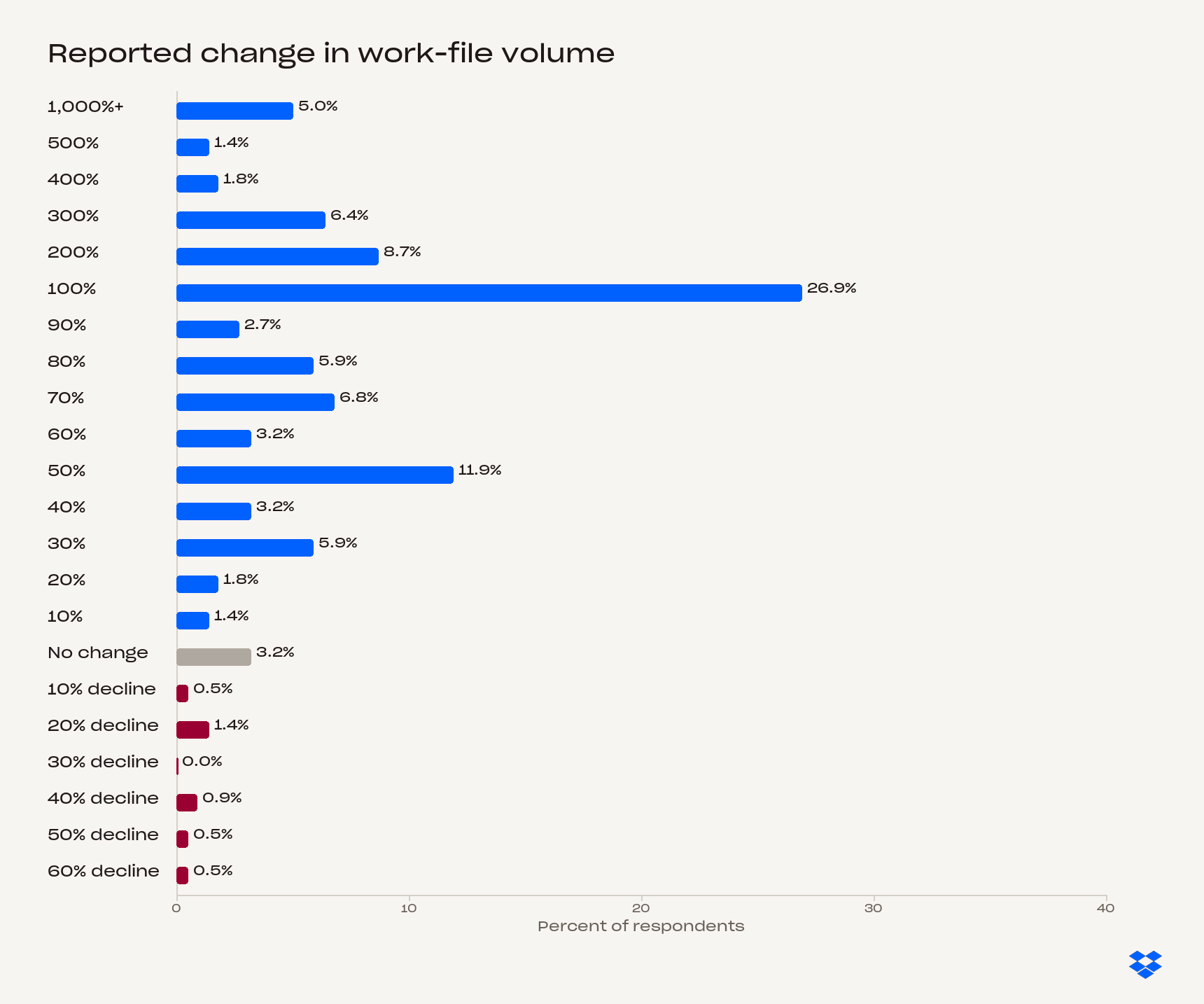
50.2% of respondents report that their new work-file output has not less than doubled, together with 23.3% whose output has not less than tripled. Essentially the most generally reported progress charge throughout 26.9% of individuals was a 100% enhance in new work-file output—over two instances greater than the following highest progress enhance. However what actually stands out is that extra folks report +1,000% progress in file creation with AI vs. people who reported a decline.
This rising output brings extra content material to assessment, arrange, share, and keep throughout the enterprise. A number of drafts, supporting recordsdata, and audience-specific variations could make it more durable to establish the newest data and protect the context behind it. As file volumes develop, holding that content material straightforward to seek out and able to reuse turns into a part of defending the productiveness AI can create.
43.8% of helpful AI output by no means leaves the immediate
As soon as AI creates one thing helpful, the place does it go? All of the highly effective output is simply helpful if we and others can discover, assessment, and construct on it. A proposal might have to succeed in a shared folder, an evaluation could grow to be a part of an present report, and a venture replace could enter one other enterprise workflow. But when helpful outcomes stay contained in the AI dialog, colleagues won’t ever have visibility into this work.
On common, folks observe 2.2 routes for helpful AI output last locations, and sadly for 43.8% of us, this convenient output by no means leaves their immediate. Shared workforce workspaces lead because the #1 helpful AI output vacation spot at 45.2%, intently adopted by private or native recordsdata at 44.3%.
Right here’s the place respondents say helpful AI output finally ends up:
- 45.2% put it aside in a shared workforce workspace (e.g., Dropbox, OneDrive)
- 44.3% put it aside as a brand new private or native file
- 43.8% depart it within the AI dialog
- 28.8% copy it into an present file
- 25.1% enter it into one other enterprise utility or workflow
- 22.8% share it by way of electronic mail or messaging
- 6.8% aren’t certain the place it finally ends up
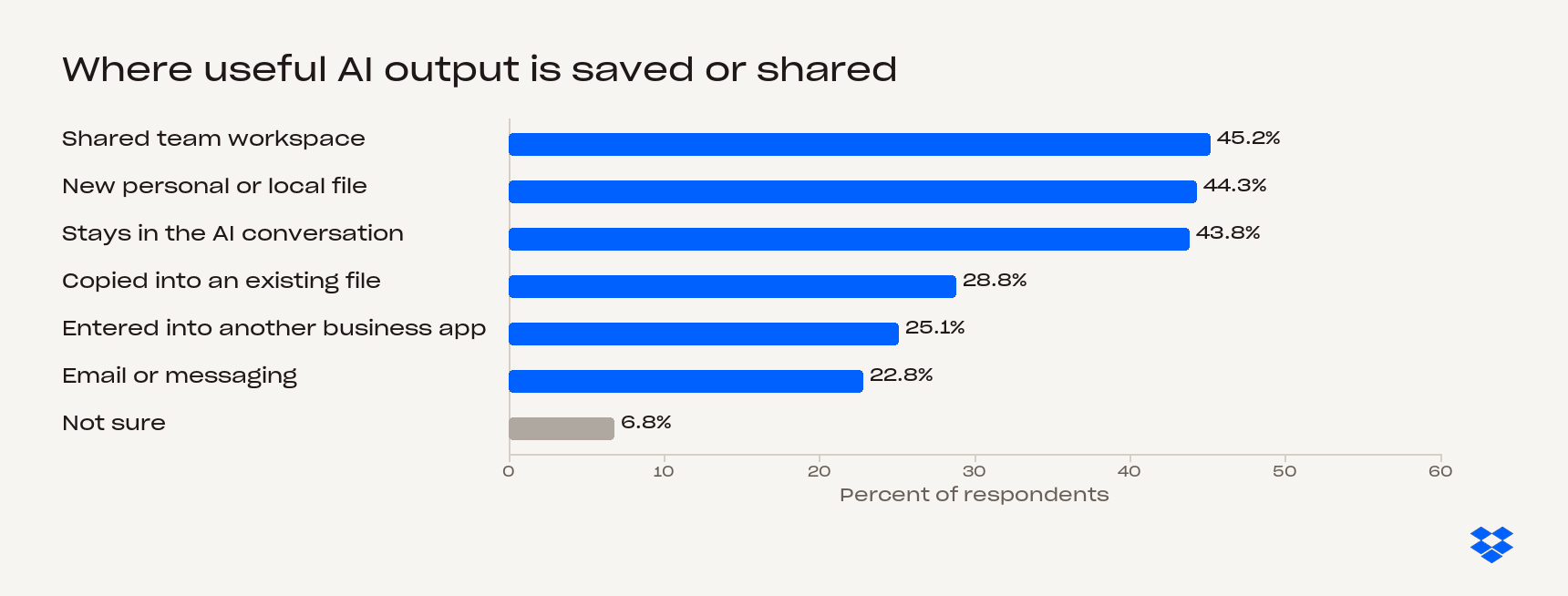
The three main locations are almost tied, exhibiting how helpful AI work spreads throughout shared, particular person, and conversational environments. That creates a possible hole between producing one thing helpful and making it accessible for colleagues to make use of.
For companies, the vacation spot of AI-generated work issues alongside the amount being created. As output grows, groups want methods to make helpful outcomes discoverable, protect related context, and maintain variations clear. In any other case, helpful work can grow to be one other piece of data somebody should observe down earlier than their subsequent activity can transfer ahead.
Turning AI output into lasting enterprise worth
AI is altering each how folks work and the way a lot content material they produce. Our analysis reveals a considerable funding of time in AI, repeated efforts to provide context, and rising file volumes. Helpful outcomes then unfold throughout shared workspaces, private recordsdata, enterprise functions, and conversations—creating extra data for groups to handle and construct on.
Collectively, these findings level to a rising enterprise precedence: connecting the information AI wants with the work it helps create. Simpler entry to related data might scale back time spent gathering context, whereas higher group of helpful output might assist that work maintain its worth throughout a workforce.
5 key takeaways stand out:
- AI occupies 15.8 hours every week of our time at work, on common
- 36.6% of AI time is wasted retrieving context, with 4.3 further context rounds per activity
- $577K in potential annual productiveness worth from halving retrieval time throughout 100 staff
- 46.4% of recent recordsdata at the moment are formed by AI
- 43.8% of helpful AI output by no means leaves the immediate
For enterprise leaders, the chance is to make your entire workflow extra productive—from discovering the fitting supply materials to preserving a helpful consequence. As AI-assisted content material grows, making that work accessible, comprehensible, and able to reuse turns into a part of sustaining its worth.

