


All images courtesy of Jean Garnett.
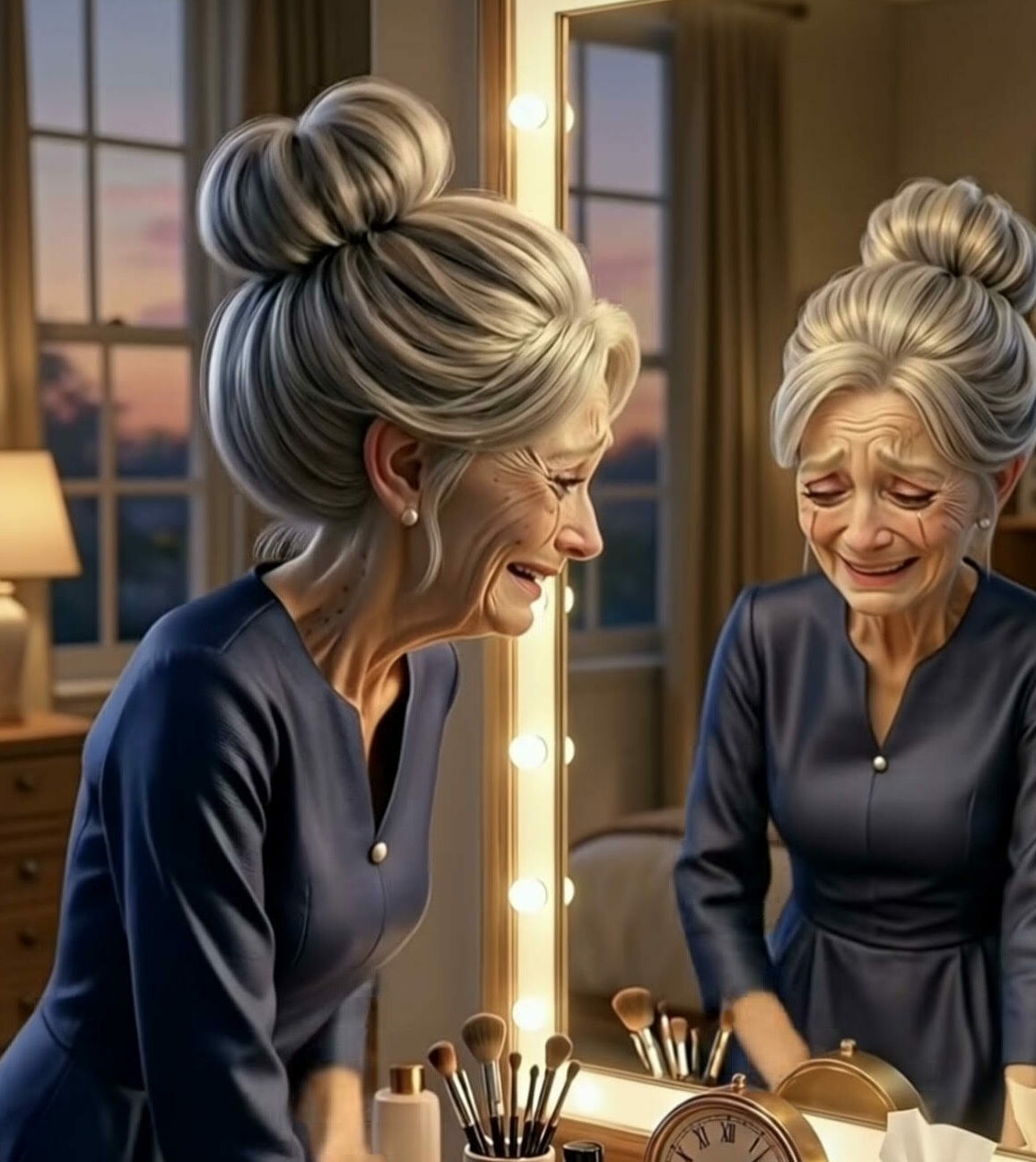
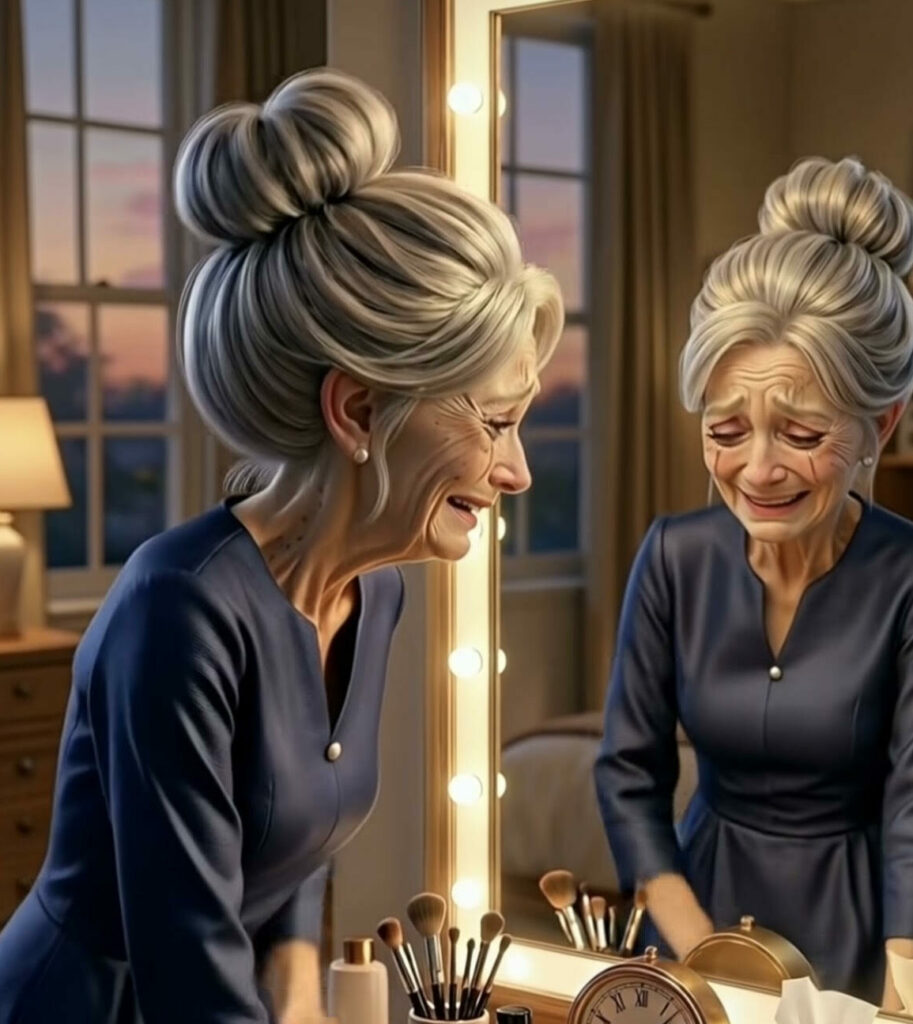
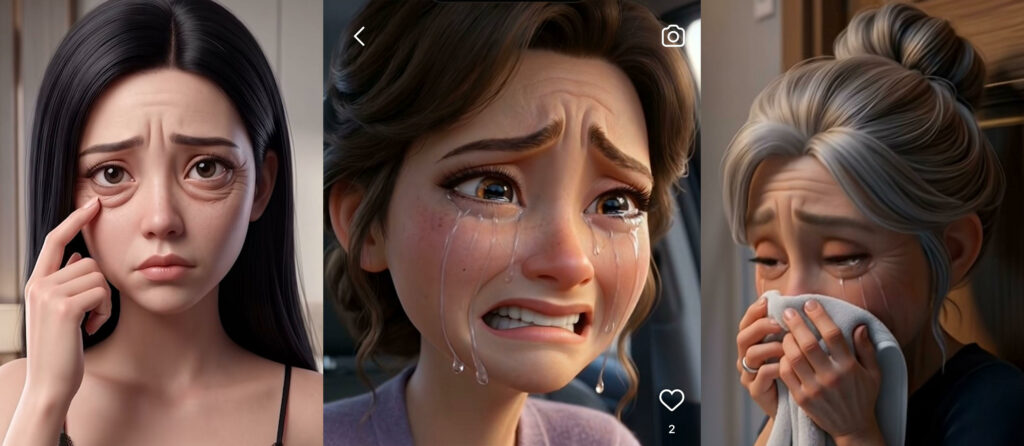
The tears are the primary inform, and what stops my scrolling: that’s not how tears work. The tears collect in vast, frightened eyes and spill over into droplets, however as an alternative of sliding down the cheek and being absorbed into the pores and skin or dripping off the face, these droplets dangle like snot from the eyes, clear swells dragging down mucous threads.
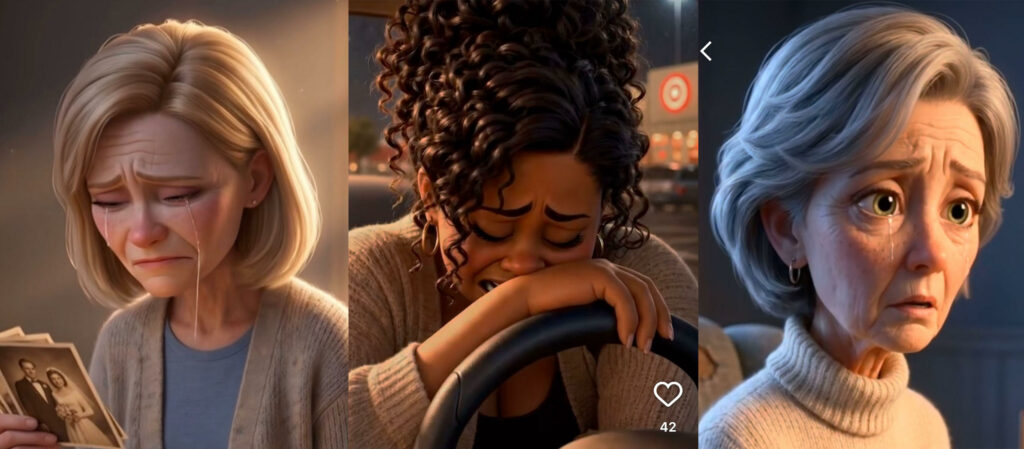
The eyes belong to a girl, a Pixaresque determine with a big head on a hunched physique, who’s crying in her cubicle. In subsequent variations she could also be crying within the rest room, or on the wheel of her automotive, or at her son’s soccer sport or her daughter’s rehearsal dinner, however the reason for the tears is at all times the identical: the girl is unhappy as a result of she is growing older, and she or he is growing older as a result of she is unhappy. She is a rumpled Möbius strip of trigger and impact, agedness the overall reality of her life. Naturally, the girl has failed, or is failing, to hold onto her husband: “You used to mild up,” he says in a single video. “You simply don’t seem like your self anymore.” Or she overhears him telling a good friend that she has “let herself go.” Or he has already left her for a a lot youthful lady. Or he’s having an affair with a colleague who has not “let herself go.”
Who will care about our heroine sufficient to cease her from permitting feminine age to occur to her? Who will step in? Generally it’s the girl’s sister, who simply received again from a enterprise journey to Seoul. Generally it’s her good friend or colleague who works in Seoul. Generally the intervener is the girl’s daughter, who leaks goopy tears as she watches her father stride off into a brand new life along with his a lot youthful girlfriend. On this case, the daughter, compelled to share in her mom’s humiliation, units out to “save face”—her mom’s actually, her personal figuratively—by way of the hydrating gel masks, or the serum, or the nonoxidizing basis, or no matter it’s.
The brand new form of skincare advert that’s instantly showing each time I swipe by Instagram Reels is a subgenre in a rampant class that I’ve come to think about as “Purification Slop,” clearly AI-generated advertising content material interesting to and visualizing my fantasy that what ails me, together with age, might be rendered isolable and extricable from me. The Intelligence is aware of that I thrill to depictions of something “constructed up” inside me lastly popping out. Am I conscious that if, standing in a kitchen sunbeam, I take one sip of this mushroom beverage, cute little probiotics will go tra-la-la chimney sweeping by my intestines like Dick Van Dyke, making me positively glow with interior cleanness? Have I used this jade curler to empty my lymphatic fluid these days, or am I cool with internet hosting putrid waste in my corpus? The Intelligence can also know that I’m single, that mirrors have change into difficult for me—that it is dependent upon the sunshine, it is dependent upon my temper.
These adverts are infomercials, fake-science-wise, limited-time-offer-wise. However they really feel extra like mini cleaning soap operas (I simply timed one at over ten minutes); they’re extraordinarily emo. Every Growing older Lady Emomercial (AWE) tells a songified story, most frequently paying homage to Taylor Swift or Olivia Rodrigo, constructing from confiding, conversational grief to a pleadingly triumphal refrain. It begins with a tearfully juicy hook: “That is the story of the day he walked away.” Or “My ex-husband walked in with the girl he left me for, younger sufficient to be our daughter.” Or, in a single case the place the girl is Black, “I bumped into my child daddy at daycare drop-off with the bitch he left me for.”
Again once I was twenty, a hip restaurateur employed me to beat the shit out of a bunch of brand name new tables. I received to spend a complete summer season attacking mahogany with heavy chains, gouging it with chisels, sanding and marking and scraping and carving imaginary lovers’ initials into it. In a matter of weeks, I used to be to impart to this wooden the looks of wear and tear that many years bestow on life’s helpful objects. The restaurateur, himself tastefully distressed in his fifties and far wanted, paid me to do that as a result of aged furnishings would make a brand new bistro really feel storied and intimate. In AWEs, as so typically in our world, age sits on the person like that, as environment, authority, sturdiness, vitality. Even his losses—of pigment from hair, or moisture from pores and skin, or burdensome spouse and children from life—confer a patina of worth. After in regards to the fifth AWE in a row, it begins to look miraculous that any growing older man stays with any growing older lady. How can his “age” even be in the identical room as hers?
The “double commonplace of growing older,” as Susan Sontag referred to as it, is nothing new. What’s new is its refraction by a big language mannequin that has just lately gone emotionally bionic. From the daybreak of AI till just some years in the past, the enterprise and advertising worlds operated beneath the idea, primarily based on many years of analysis, that buyers are usually “algorithm averse,” that we have a tendency to withstand programmed “you may additionally like” strategies, and that even the place statistical prediction proved extra correct than its human counterpart (in, for instance, sure medical diagnoses), individuals had been biased in favor of subjective judgments. One paradigm-shifting second got here in 2020, when Chiara Longoni and Luca Cian printed a paper within the Journal of Advertising and marketing figuring out what they referred to as the “word-of-machine” impact. Our algorithm aversion, they stated, was not common however conditional. Shoppers with a “utilitarian” objective—these looking for a product to meet a particular, clear operate, akin to dental floss—really tended to worth and belief AI suggestions extra. It was solely these of us pursuing a “hedonic” objective—a sensory or emotional expertise, as in a horror film—who nonetheless most popular to listen to it from a human’s mouth.
The sorting of want into clear “utilitarian” vs. “hedonic” modes had, on the time of Longoni and Cian’s paper, been advertising orthodoxy because the eighties, when researchers launched the “hedonic viewpoint” as a necessary instrument in understanding in any other case inexplicable consumption phenomena—for instance, our attraction to sure media exactly as a result of it causes us ache. A tenet of self-consciously affective capitalism, the hedonic viewpoint is a form of strategic empathy, drawing consideration from the article (product) to the topic (client), a love-seeking being in want of emotional launch. By 2026, AI has transcended its utilitarian sphere to imagine, or at the least enact, one thing just like the hedonic viewpoint, its capacity to imitate emotional literacy with facility and precision giving the “word-of-machine” totally different and extra disarming valencies. Can a robotic promote me a sense now? Can it achieve this even whereas being clearly a robotic?
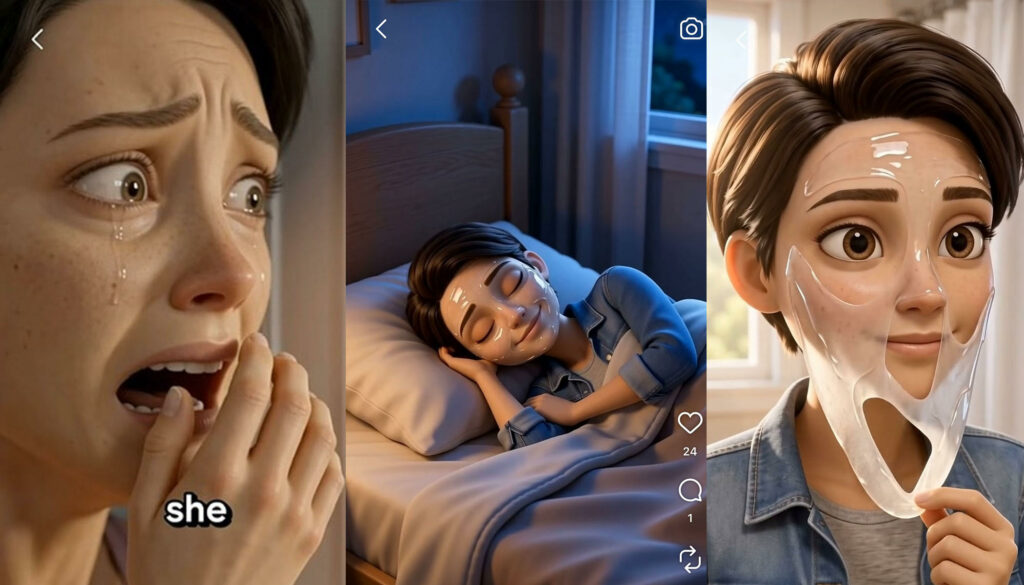
The American “Okay-beauty” manufacturers that run probably the most Growing older Lady Emomercials—manufacturers like Quasi, Yuri, and Koriderm—don’t disclose that their adverts are AI slop, as New York State regulation now requires, however the adverts themselves disclose it. The lip sync is off, the outfits change midscene, the soar cuts soar humorous, the tears dangle like scorching glue, the script goes wonky: one lady is “fifty-three-forty” years previous; different moisturizers in the marketplace “evaporate like glass.” All of those useless giveaways create a brand new form of distance between the adverts and the businesses behind them that affords the latter a sure believable deniability. This behooves them, as a result of AWEs go low—very low, even by advert requirements. In a single, our pre-glow-up heroine asks her daughter: “How can I be cherished once I seem like this?”
Whom can we rage towards right here? Is our rage even roused? The factor is, clocking instantly that an AWE is AI, I apprehend it in another way than I might a man-made advert, not a lot as a brutally strategic snake-oil con job, however as a set of impressions, amalgamations, whispers from the ether. It’s like listening to a toddler repeat what they’ve heard the grown-ups say. I discover that, for me, the “word-of-machine” impact is inverted right here; I’m someway much less guarded towards emotional manipulation when there isn’t a one to take inventive duty.
Growing older Lady Emomercials go low not solely sociologically however affectively, in ways in which really feel intimately acquainted and even a bit radical in an advert context. These ladies should not simply having a nasty day, not simply dysregulated. These should not the wives of most commercials in my lifetime, frivolously exasperated by a juice stain or decorously anxious over debt; they aren’t even the indoor brooders of gentle-voiced pharmaceutical adverts. These ladies are approach, approach down, in harmful despair and perimenopausal nervous breakdown territory. They’re grieving, they’re having a panic assault, they’re heaving and sobbing on the ground, they’re disgusted with themselves, they wish to crawl out of their sagging pores and skin, they’re shutting themselves away from the world, they’re considering skipping their daughter’s wedding ceremony in order to not need to be seen in public. Like a robotic’s thought of a teardrop, they’re hanging by a thread.
This mix of manosphere-style gender realpolitik and all-too-human midlife emotional breakdown confers on these AI melodramas a bizarre and, to me, scary cathartic energy. Ladies perceive, from very early in life, that feminine growing older represents social dying; we spend our lives metabolizing this, and we’re used to media that displays our knowingness. We have now believed ourselves acclimated, believed ourselves advanced. We all know that it’s puerile and morbid and weak to catastrophize a pure course of. However now listed below are these micro dramas presenting social truism as tragic private revelation, providing us an opportunity to expertise afresh—that’s, as youngsters, or as nonhuman creatures, or as particular people—the ache and injustice of a girl’s relationship to time.
The reality is that most of the ladies I do know are periodically falling aside over their altering faces. Even the clever ones, even those who know higher—particularly those who know higher, since their nervousness is compounded by guilt over their very own shallowness. In an uncanny twist on the trope of the impassive robotic, right here AI is brazenly acknowledging emotional truths—albeit hackneyed ones—which have, maybe rightly, change into distasteful to specific in clever, moral human firm. We’re what we predict and say we’re, so let’s not go low. However low is an actual place, and by “going there” the robotic enacts the promised operate of the product: it makes me really feel seen. “The second,” sings one AWE lady the morning after carrying the touted collagen masks to mattress, “was me alone in that mirror lastly seeing myself clearly.”
The important thing “second” in each AWE claims to be about self-reclamation, confidence, “lastly recognizing” your self, however in fact it’s, each time, about one thing else. The climactic sequence that the narrative builds towards, the hovering a part of the tune, the fantasy’s apex, is the run-in with the person who left. The lady is post-product now, post-restoration to her genuine scorching younger self, and post-epiphany in regards to the true drawback: “It isn’t self-importance,” she belts in yet one more pre-chorus, “it’s not in your head, it’s not age, your pores and skin is ravenous.”
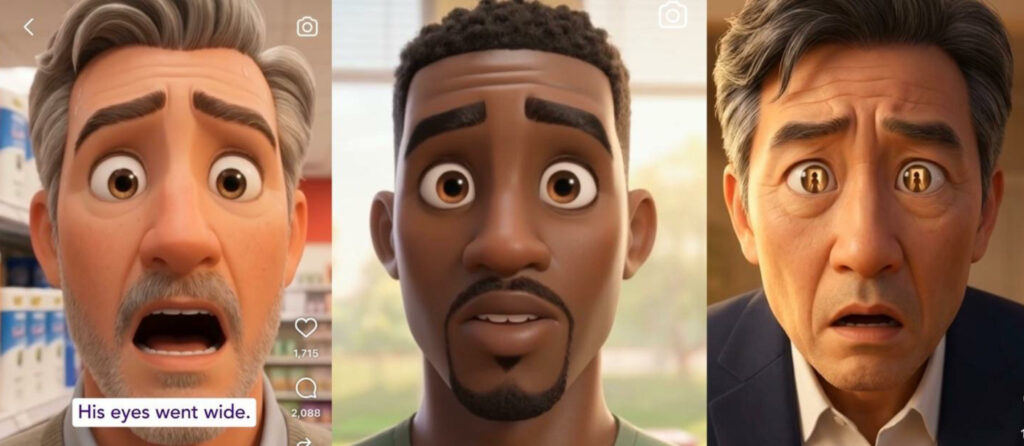
After which there he’s, on the pharmacy, at day care drop-off, on the restaurant the place our heroine is awaiting her first date in years. He sees her, her face plumped and poreless as a toddler’s, and one thing occurs to him: his eyes bulge, his eyebrows shoot up, his lips cling open; he nearly does a full “awooga.” Having “anticipated to see the previous damaged face,” he finds as an alternative a “radiant lady standing tall,” and he’s so fully shocked by the transformation that he now turns into the damaged one—for a couple of seconds we get to revel on this picture of the male gaze frozen in a paroxysm of “humina humina” stupidity. Then the girl dutifully pivots to disclaiming any want to get him again, and does somewhat I-did-this-for-me shuffle into the “purchase now whereas provides final” conclusion.
Not too long ago I had my very own run-in second. I used to be alone at a New York Metropolis seaside. I’d been there for a couple of hours, in good climate, however, seeing a mass of darkish clouds rolling in, I gathered my issues and fast-walked the trail by the dunes to the exit. I rounded a bend and there, strolling simply forward of me, was the person who left two years in the past. He was strolling near somebody, shut sufficient to the touch arm hairs. “Hello,” I stated to the again of them, and so they stopped, half turned.
Not like the AWE males, this man didn’t appear in any respect shocked to see me. In actual fact, each he and his companion took my look so stolidly in stride that I questioned whether or not they had seen me earlier, maybe from afar, and had taken pains to keep away from me, not anticipating the clouds to flush us out collectively.
We had been simply reaching the tip of the trail as I referred to as out, arriving at a gap in a chain-link fence the place you permit the dunes and cross a subject to get to the street. The lady, who was tall and muscular and at the least ten years my junior, stepped apart and abstracted herself, as if we had been in a museum and she or he had crossed to treat a portray on the alternative wall. I waved to her and she or he gave me a strained smile as the person knelt to placed on his sneakers.
I stood there saying phrases, I don’t know which of them. From the bottom, the person appeared to be apologizing to me for one thing—I have to forgive him for being at this second too distracted to correctly work together, however he had just lately seen a video of an individual being struck by lightning, and so he was afraid of being struck by lightning himself, right here, now, and he gestured to the approaching cloud shelf. For some purpose, inside that second, this concern struck me as rational.
The scene proceeded in nightmare time. Now I appeared to be apologizing for one thing. I didn’t imply to make him, them, uncomfortable; I may cross the sector individually, and I turned and began to stroll away, however after a couple of yards I shocked myself by turning again and yelling at them. “Peace!” I shouted quite aggressively, “peace!” However the man couldn’t hear me so he stood up and jogged towards me. “It doesn’t need to be bizarre,” I stated, or I sang it like somewhat jingle because the younger lady walked slowly as much as be part of us and now he correctly launched us, and we shook fingers. We walked three abreast towards the clouds that had been coming to satisfy us. I stated the place I used to be headed for the night and when the younger lady indicated that she knew the place I nodded eagerly, “yeah, sure!” I used to be so grateful to her for corroborating me. “Your sneakers are untied,” the girl instructed the person, “simply letting ,” and all of us regarded down at his shoelaces dragging by the grass as we walked. “I’ve to pee,” she stated instantly, and peeled off within the route of the low-slung concrete constructing within the heart of the sector the place the restrooms are, and the person stopped and I stored strolling and proper then the rain began, a couple of chilly drops after which a torrent, sheets of it, a hydrating masks over the entire scene, and I broke right into a run to my automotive a couple of blocks down and received in soaking moist and pulled the door shut.
We would like the individuals who left us to see how we now have improved ourselves. If loving them made us higher individuals, dropping them has made us higher nonetheless. We’re more durable now, we now have extra colours to color with: power dark-value sorrows, neon joys; we’re extra alive than we now have ever been. That is what shocks me most about getting older—I maintain changing into extra alive. To outwardly droop and look drained at this juncture quantities to failure of illustration so perverse that one can’t assist imputing some intelligence to it; one feels contrapasso punished for the crime of caring about look.
The Intelligence, we’re instructed, can be changing into extra alive, or at the least extra autonomous. I maintain listening to that what we have to concern now—not far off however subsequent yr, possibly this yr—is the Intelligence’s penchant for “recursive self-improvement,” which can at any time explode into violent company, turning on us like a smitingly stunning fifty-three-forty-year-old ex-wife whose energy has been underestimated. “That is what you get,” it says, “for considering you may watch me paradoxically.”
“What’s that?” my daughter asks now, eying the pink field I’m holding, whose emblem resembles the killer’s masks from Scream.
“It’s simply one thing for my face,” I say, “to make my pores and skin higher.”
“Don’t use it,” she says shortly, shaking her head. “Don’t imagine that form of factor.” Generally when an advert interrupts a program we’re streaming, she is going to inform me, answering an unstated immediate, what drawback this advert has invented as a way to promote us an answer.
“Mother, for actual,” she says now, and I see that she’s genuinely anxious in regards to the masks, and I feel how scary it might be for her if it labored as marketed, making me unfamiliar to her.
“You’re proper,” I say. “You’re so good. I shouldn’t have purchased it. I received’t use it.” And I carry it off as if to throw it away and slip it beneath a pile of books in my bed room for some night time when she’s sleeping at her dad’s.

