



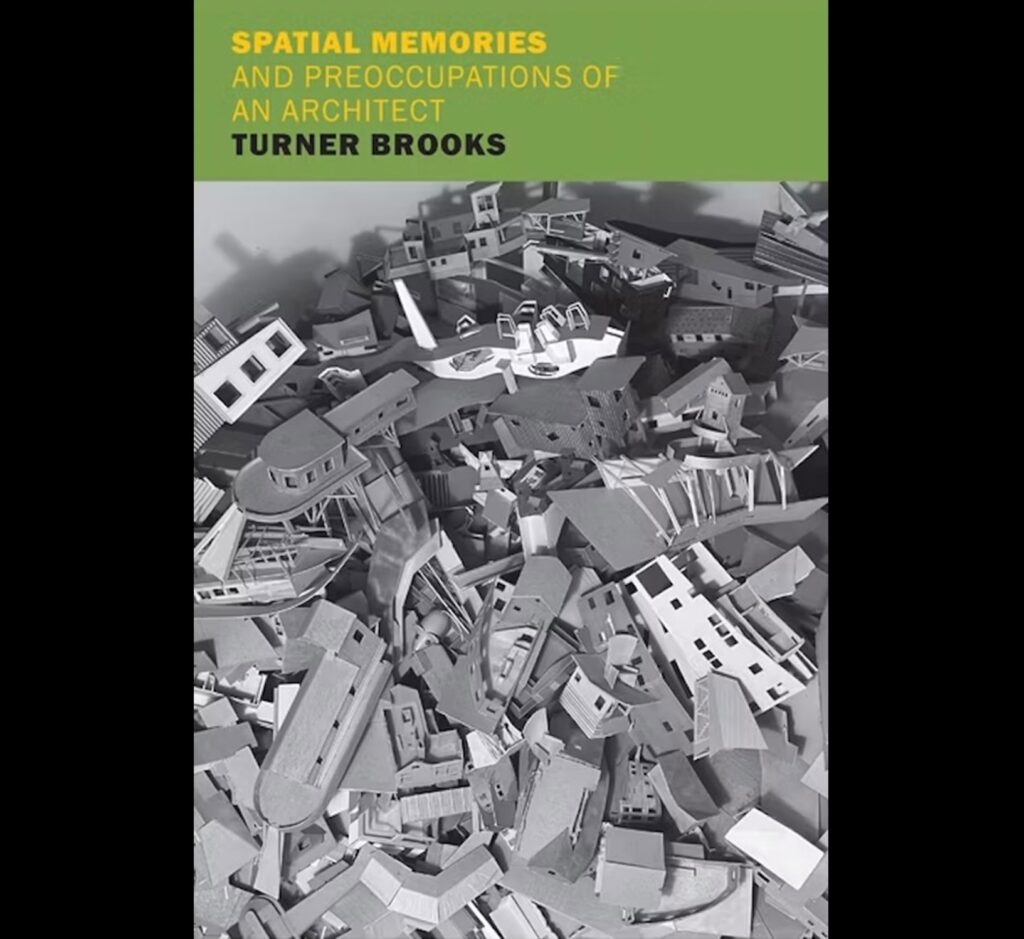
As a baby, Turner Brooks would lie awake within the smallest bed room of a creaky seaside home in Maine. From under, he might hear his grandparents speaking in the lounge, and from the window, the crashing waves of the Atlantic Ocean. These two sounds grew to become, for him, as a lot part of the bed room as its Dutch wallpaper—what he would come to name a “spatial reminiscence.” Years later, whereas finding out on the Yale College of Structure, considered one of Brooks’s classmates glossed the concept like this: “should you eliminated the ground, partitions, and ceiling, the area would nonetheless be there.”
The twenty brief items in Brooks’s new essay assortment, Spatial Recollections and Preoccupations of an Architect, take up this concept, this notion that our psychological experiences inside architectural buildings have the facility to form them. He examines buildings much less as ends in themselves than as prisms for the human dramas they comprise. In a single chapter, he describes Grand Central Terminal as a womb from which different locations are born. In one other, he imagines that the columns of the Bibliothèque nationale de France tether its ceiling to its flooring, in order that it doesn’t inflate with its occupants’ buoyant ideas and float away. Elsewhere, Brooks’s sensibility is extra eclectic. His temporary vignettes, neither solely argument nor private essay, mix architectural impressions from childhood with topics as disparate because the artwork of Edward Hopper, midcentury French philosophy, Clement Hurd’s illustrations for Goodnight Moon, and steam-propelled bathtub toys.
Since graduating from Yale and finishing a brief stint working for the Modernist Philip Johnson, Brooks has spent the previous fifty years practising as an architect in and round New England. His work features a assortment of rural polygonal homes, a residential campus for individuals with autism, a subterranean museum of brains floating in formaldehyde, and a theater that appears like a steamboat. Lots of his buildings are formed like ships; a few of them actually transfer. He made Yale’s Gilder Boathouse look, as he places it within the guide, prefer it “beached itself on the riverbank” of the Housatonic. He positioned the Peek Home in Vermont to appear like it was “resting on mudflats ready to drift off with the rising tide.” The final Brooks heard of the Laffin Home, which he designed on an eight-foot-wide metal body with wheels, it was crossing the border into Canada.
It follows, then, that Spatial Recollections portrays buildings as interlocutors between inside areas and the immense environments that encompass them. Early on within the guide, Brooks remembers engulfing himself in his father’s monumental furry overcoat: “Searching down the lengthy hall of sleeve, I felt the world exterior to be a way more inviting place than it was with out this further layer.” He discovered an identical expertise inside his childhood tree home—spying on his environment from the darkish perch appeared to remodel his desolate, detached panorama into one thing benign and symbiotic. Once I was that age, my aunt’s home had an old style laundry chute. I used to be sufficiently small then to crawl down it from the highest flooring all the best way to the basement. The passage’s cloistral and clandestine character was extra interesting than its utility. I imagined I might climb in and come out anyplace. (That home was demolished years in the past, although I typically surprise if I might discover the area the place I as soon as sat.)
The buildings that the grownup Brooks likes and designs are replete with mazes, alternate routes, areas inside areas. He loves a secret backyard, exulting in labyrinthine areas as a result of they power us to “reconnoiter with the place one is, the place one is coming from, and the place one goes to subsequent.” One in every of his main influences relating to the advantage of architectural interstices is Kafka’s brief story “The Burrow,” by which an unidentified animal loses itself, to Brooks’s delight, within the tangled bowels of its personal den to elude house invaders. One other is Sir John Soane’s Museum in London. Visiting Soane’s Frankensteinian Georgian townhouses, he discovered that, although their “areas are intimate, the wandering amongst them, as amongst bushes in a forest, appears infinite.” He sees in each the Kafka story and the museum some echo of his personal philosophy: that what we endure inside a piece of structure is encoded in its infrastructure and blueprint, its tangible twists and turns.
In his chapter on work, Brooks finds his personal preoccupation with the permeability of social life and bodily area mirrored in historic masterpieces like Fra Angelico’s Annunciation. Within the portray of the angel Gabriel’s go to to the Virgin Mary, he attends to the best way by which the ideas of Gabriel’s wings appear to increase into, or protrude from, two pillars of the encircling colonnade, seeming to make him steady along with his environs. In Hopper’s Rooms by the Sea, in the meantime, Brooks sees spatial orientations that reorder our conception of the bodily world, paying homage to his childhood bed room in Maine: “The central clean wall with the diagonal swath of daylight turns into a liminal zone between the huge ocean and the little home area.” Each works emphasize the connections a constructing attracts between the universe round it and its personal interiors, merging what we see on the market with what we really feel in right here.
Brooks would say that the very best structure channels the strain between right here and there, between tactility and emotion: “Usually it’s the pulsation between two intentionally ambiguously completely different volumetric readings of the area that brings the work to life.” Definitely one finds that stress at play in his personal constructions. As Jonathan Schell wrote within the 1995 monograph Turner Brooks: Work, “It’s arduous to consider a single home of Brooks’s that doesn’t bear some resemblance to an animal, a car, a machine, and a human being.”
I lately visited Brooks’s Cushing Heart on the Yale College of Medication. The tiny museum, tucked in a nook of the medical library, homes tons of of mind and tumor specimens, in addition to hundreds of photograph negatives and microscope slides—the gathering of the neurosurgery pioneer Harvey Cushing. I went as a result of I needed to see for myself its unorthodox assortment of floating brains, but in addition to expertise firsthand how Brooks’s idea of spatial reminiscence may have interaction with an area dedicated to the thoughts.
The small room turned in on itself like a maze, lined with polished wooden and curved glass cupboards, a gesture on the folds and grooves within the organs they comprise. As I assessed the structure, I saved getting startled by the shows—the bodily leftovers of tons of of human minds. Their shapes had been all barely completely different. Some bore the marks of obscure neuropathologies, although that alone wouldn’t account for the diploma of variation. I discovered myself questioning if every line had been etched by some predetermined genetic code, or if they’d been sculpted by a lifetime of expertise. Brooks may say, What’s the distinction?
Alessandro Tersigni is a author whose work has appeared in the New York Instances and The Believer. He lives in Toronto.

