



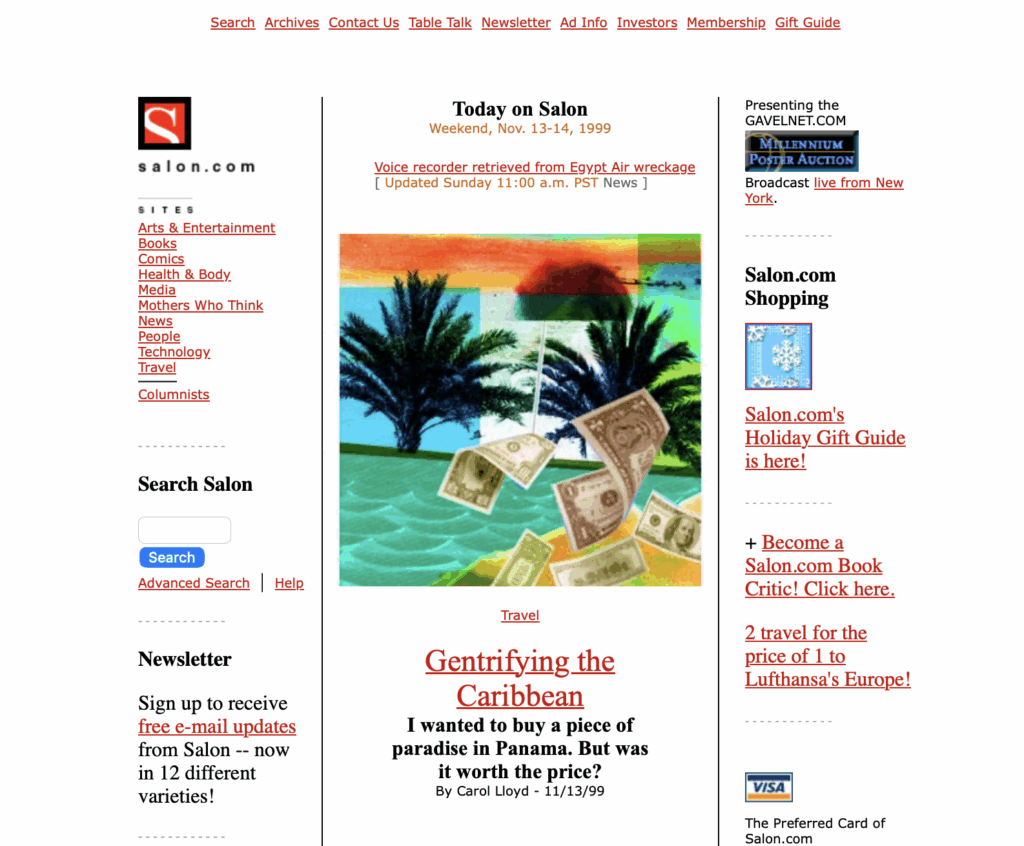
The house web page of Salon’s web site in November 1999.
Within the dying days of 1995, I used to be a contract journalist in Portland, Oregon, who spent most of my time seated at a rickety particle-board desk, a present from my father-in-law. The desk was coated in faux-walnut laminate and swayed backward and forward as I wrote. I had already completed my foremost monetary gusher for that yr, a historical past e book for fifth graders, and I wanted extra work.
On this respect I used to be no totally different than any freelancer in literary historical past. In actual fact, the expertise concerned in my commerce, and the pace at which it functioned—its industrial metabolism—had hardly modified within the previous century. In fact, I had a pc. But it surely hardly appeared to be far more than a glorified typewriter. And naturally I had an electronic mail account, courtesy of the nerd Valhalla generally known as CompuServe. However the enterprise of freelance journalism was nonetheless constructed largely round stuffing wads of paper into envelopes and sending them to editors, who would then remodel the contents into different wads of paper: newspapers, magazines, books. The product, no matter you considered it, was palpable.
Into this cozy Victorian setting got here a web based publication referred to as Salon. It had been launched that very same fall by a crew of ex-staffers from the San Francisco Examiner, conventional journalists attempting to interrupt the mould. I don’t bear in mind which Salon editor contacted me within the first place. I do bear in mind studying the web site in my chilly little workplace, steadying the silly desk with one leg and feeling an nearly metaphysical puzzlement. Salon wasn’t some programmer’s pastime, whipped up in creaky previous COBOL. It seemed like {a magazine}, with zippy graphics and respectable fonts. The prose was sensible, trendy, and amusingly contrarian.
All of this made a type of sense to me. What was difficult was that it was free. That first afternoon, I printed out one of many articles, about The Beatles Anthology, which was simply then airing on TV. I suppose I used to be turning again the technological clock—transubstantiating the product again into paper. Studying Salon free of charge made me really feel as if I had been doing one thing furtive, as if I had been a shoplifter, nevertheless it represented a type of post-Gutenberg freedom.
Over the subsequent yr, I might write many items for Salon. I began out with e book opinions that had been assigned to me by Dwight Garner. (He had beforehand edited a couple of issues of mine at Vogue, by way of ethos absolutely the inverse of Salon and, ultimately, by way of funds too.) Dwight despatched me books by the bushel, or so it felt. I wrote very quick items for him in a short time; they appeared on-line nearly instantly. This, for the journalist, was unprecedented and practically beggared perception. No extra ready to your piece to come back out, pacing the equal of a widow’s stroll. Typically I used to be even instructed to ship the piece straight to the copy editor so we might lower a couple of extra minutes out of the method.
Speediness of reflexes was a part of the worth proposition for Salon. Inside months, the “sensible tabloid,” as its founder David Talbot referred to as it, was posting every day relatively than weekly. On this method it inaugurated a fireplace hose model of journalism that may in time turn into common. The brand new norm was not ready, not permitting tales to lose their warmth within the cooling saucer of traditional media.
Salon’s politics had been equally nontraditional: left-leaning, libertarian-adjacent (as per its Bay Space digs), however with out an apparent get together line. It likely helped that the journal was not a subsidiary of a bigger company, which was the case with Slate (a part of Microsoft) and the sooner, cruder Mr. Showbiz (a part of Starwave, a short-lived multimedia platform based by Microsoft’s Paul Allen). Sure, Salon’s seed funding had come from Apple—a mingy $60,000—adopted by a extra substantial disbursement to the tune of $2 million from the Adobe cofounder John Warnock and numerous different buyers. But it surely was an impartial entity, unconstrained by the necessity to tiptoe across the emotions of a company proprietor.
In any case, I wasn’t writing about politics. I used to be writing about tradition: the journal’s robust go well with. From books I branched into music—I consider it was Joyce Millman, Salon’s tv critic, who assigned me items about Prince, Los Lobos, Invoice Frisell, Cassandra Wilson. These had been my enthusiasms, not the type of dutiful, indiscriminate protection {that a} film-critic buddy of mine as soon as likened to servicing a merchandising machine. I used to be allowed to enterprise additional nonetheless once I pitched a chunk about Martin Scorsese’s use of music. (The On line casino soundtrack, I wrote, struck me as what the director would possibly hearken to “if he had been shipwrecked with nothing however a polyester go well with and a financial institution of slot machines.”)
It wasn’t lengthy earlier than I used to be writing quick private essays. I wrote one about being hoaxed by the founding father of the Church of Kurt Cobain, which turned out to be nonexistent, though definitely believable within the drizzling, grunge-friendly ambiance of Portland. I wrote one other about turning into hooked on All My Youngsters throughout a critical household well being disaster within the midst of which I discovered myself unusually impressed by the surreal resiliency of the characters, who by no means died until their respective actor’s contracts with the present expired. I’m not making any excessive claims for these items. They had been written on the madcap tempo dictated by Salon and sandwiched between different freelance explorations—of dental malocclusion or aluminum smelting, say. For me, although, they nonetheless evoke the adrenaline really feel of the interval, the wild sense of collaborating in one thing new and transformative.
Regardless of the fixed move of assignments from Salon, my paychecks, which nonetheless arrived by mail, had been modest. A few yr after I started writing for the web site, and underneath persevering with monetary stress, I accepted a job supply from a tiny startup that I assumed would go bankrupt inside a yr: Amazon. I drove a diesel truck with all our belongings, minus the flimsy desk, as much as Seattle. In a method, the nonstop dash and kooky brevity of Salon had made for a type of boot camp for what would observe at my new gig. You needed to be quick, sooner, quickest. Quickly sufficient, I might be keeping off the arguments of my Amazon supervisors {that a} 150-word e book evaluation was too lengthy.
I hoped I’d preserve my connection to the journal, however Salon had entered right into a type of company dalliance with Borders. That made me a fifth-column traitor, simply because it had when the New York Occasions Guide Overview signed an analogous take care of Barnes & Noble. (“I’m afraid you’re on the opposite group now,” my longtime editor on the Guide Overview defined throughout a clumsy cellphone name.) But in 2004, by which period I had left Amazon and the retail mark of Cain had been washed from my brow, Salon ran an extended excerpt from my e book Amazonia and paired it with an effusive evaluation. Naturally, I hoped that the reviewer’s reward was honest. However I additionally noticed the eye as a tacit recognition of my earlier position on the journal. I had stopped contributing, I had disappeared like a kind of post-contractual gamers on All My Youngsters—however I used to be nonetheless household, wasn’t I?
The downward trajectory of Salon, which closed its doorways for good earlier this month, is well-known. The journal pioneered not solely the rapidity and personality-driven prose of a lot fashionable journalism, but additionally its early hope that digital promoting would make up for the deficit left by giving freely the product without cost. This perception collapsed in due time. So did the nosebleed valuations of many enterprises through the dot-com growth. Salon was valued at $107 million when it went public in June 1999. (I can nonetheless recall one of many editors rejoicing to me on the cellphone: “We danced round the lounge and stated, ‘We’re wealthy, we’re wealthy!’”) Precisely twenty years later, it offered for $5 million to a pair of entrepreneurs—who then handed it alongside for pocket change to a Malta-based “efficiency advertising ecosystem” whose web site tilts powerfully towards cryptocurrency relatively than journalism.
Who is aware of what the Maltese house owners supposed. A current contributor remarked to me, “I believe the crypto enterprise that purchased Salon at all times supposed to drive it into the bottom.” Within the previous days, this might have been madness. Now it could possibly be sensible tax planning or a easy will to destruction of the kind a lot beloved by our present run of tech barons, whose artistic enterprises so usually require a mulch of wreckage underfoot. So Eden sank to grief!
And but, the tip of Salon (or of the dregs of Salon) is difficult to ponder. All these years later, with my disembodied items on the verge of vanishing, it looks like a part of my youth, too, is dipping beneath the horizon. It appears to stir in me each fond recollection and an odd, head-scratching silence. What are the suitable funeral rites? My plan is to hurriedly go to the archives, find my work, and print all of it out.

