




Ta-Nehisi Coates panel. © Siriot de la Petra.
This summer season, Pageant America, a four-day occasion that isn’t in America, launched its trailer—a supercut of iconic imagery spanning the historical past of america. Native American males using horses. A portrait of George Washington. The positioning of the 1890 Wounded Knee Bloodbath. Males digging a mass grave. Suffragists parading. Troops storming Normandy. A mushroom cloud. A rocket launch. And textual content:
Littérature.
Expositions.
60 autrices et auteurs américains.
Subsequent got here the headshots of John Grisham and Joyce Carol Oates, Laura Kasischke and Ta-Nehisi Coates, superimposed over scenes from the March on Washington. Subsequent, a ticker tape of sixty names, one in all them my husband’s, scrolled throughout footage of males marching into conflict. The principally black-and-white montage switched into coloration as Ronald Reagan signed a invoice and a aircraft smashed into the Twin Towers.
Pageant America, which is held each two years, sometimes invitations authors from throughout america, Canada, Mexico, and the Caribbean whose works have not too long ago been translated into French for a sequence of panels and workshops in Vincennes, a city simply outdoors Paris. However the 2026 lineup was one hundred pc from the united statesA. in honor of the nation’s semiquincentennial. Amongst these invited have been Alison Bechdel, Tommy Orange, Viet Thanh Nguyen, Karen Russell, Patrick Radden Keefe, and plenty of extra of our nation’s best-known working writers, plus my husband, Jake, who was affected by an acute case of impostor syndrome.
To say Jake was shocked to be included on this lineup is an understatement. His debut novel, Slime Line, was revealed so quietly by a college press that when he signed with a bigger imprint in New York for his subsequent e book, his editor nonetheless referred to him as a “debut creator.” However, a significant French writer acquired Slime Line—or because it’s identified in French, Alaska Parano—and two years after its U.S. launch, we flew from Pennsylvania to Paris to search out that he’d amassed a not-insubstantial Francophone following. His e book was entrance and heart on the NEW AND NOTABLE desk on the bookstore close to our resort. It was there, too, at a bookstore on the following block. And guess who was a STAFF PICK at Shakespeare and Firm.
Jake was beside himself with a confused type of glee. The fawning messages he’d obtained from French-language accounts on Instagram have been starting to make sense. One submit praised his novel—which is predicated on his expertise working within the commercial-fishing trade—for being an exquisite treatise on the “solidarity of magnificent losers.”
Round this time his French publicist reached out. She wished to know if he would converse to a journalist at a significant French journal for a profile because the “new voice of America.” Proof was mounting that Jake’s work was touching a really particular French sensibility. In Vincennes, I made it my mission to search out out what.
*
That’s not precisely true. That’s simply one thing journalists say to finish their opener with a little bit narrative thrust. Attending to the underside of French literary sensibilities was extra of a secondary cause for me, trailing wine and cheese. On the competition’s first full day, authors and their plus-ones have been invited to a “cocktail lunch” on the Château de Vincennes, the seat of French kings from the fourteenth by way of the seventeenth centuries. There, we chewed on skewered radish slices, skinny breads topped with charcuterie, and pert meringues within the shadow of the tallest donjon in Europe.

Château de Vincennes, CC BY-SA 4.0, by way of Wikimedia Commons.
Over drinks, I requested the competition’s head interpreter if there was any historic torture tools round. She instructed me that essentially the most horrible demise on the château had much less to do with torture than with illness. Through the Hundred Years’ Battle, King Henry V of England had retreated there shortly after the Siege of Meaux. He’d simply conquered Normandy and was close to to turning into king of France. However the man barely had time to settle into his new digs earlier than he bought dysentery and died. That was in 1422.
Observing america’s birthday in Europe is a reminder that we’ve a minuscule historical past—a cultural handicap that our literature should overcome. “In comparison with Europe,” the competition’s founder, Francis Geffard, instructed me, “it’s very current.” However, 2 hundred fifty is a pleasingly spherical quantity, and he noticed “a superb event” to make this yr’s competition concerning the U.S. It additionally allowed him to pursue what may seem to be a lofty objective: to assemble sufficient American authors, spanning generations, geographies, and identities, to see as soon as and for all “what American fiction has to say to readers outdoors of America.”
This looks like an unimaginable process till you keep in mind the one factor that unites American writers, young and old, established and rising: they may practically at all times settle for a free journey to Paris. As Francis instructed me, “It is extremely uncommon for a author to show down the invitation.”
*
After cocktail lunch, Francis was moderating “The French Style for American Literature,” a roundtable with three Francophone consultants on American letters, on the Hôtel de Ville, Vincennes’s nineteenth-century city corridor. To enter the constructing, I had first to stroll alongside a crimson carpet, flanked by a pictures exhibition that includes, amongst others, a picture of terrified migrants paddling throughout the Rio Grande. Inside, greater than 2 hundred folks had climbed the grand staircase to the wedding corridor, the place frescoed aristocrats seemed down from the partitions. The earlier competition had drawn sixty thousand folks—the press group didn’t appear to suppose this yr’s turnout can be any much less.

This was a French-language panel, and Francis’s questions hinted at sure shared assumptions amongst French readers. “We agree that American writers aren’t fairly the identical as, say, French writers,” started one. “From France, we frequently are likely to think about america as a rustic with out tradition,” started one other.
One of many panelists was Sébastien Bonifay, a Corsican author and bookseller who traveled to the U.S. greater than twenty occasions to go to his favourite American authors at their houses, typically for days at a time. His current e book, (Not) Born within the USA, recounts conferences with James Ellroy, Chris Offutt, Donald Ray Pollock, Stuart Dybek, James McBride, and extra. These are identified names, if not precisely these an American would choose. “The literature that nourishes me,” he mentioned, “is an American literature that Individuals don’t like.”
He referred to as it “a literature of the margins,” and panelists riffed on what these tough edges have been. One positioned marginal American literature in a lineage of countercultures that rail in opposition to l’institution (anglicism, pejorative)—rock and roll, psychedelia, punk. One other mentioned that america has two literatures: one in all “the coasts” and one in all “the opposite,” hardly ever revealed however typically glorious. This thrilling literature of the margins was typically revealed by universities, which, the panelist mentioned, “have great presses.” It didn’t matter that any such e book didn’t at all times obtain mainstream acclaim; the panelists appeared to belief their very own style.
The extra the panelists riffed, the extra they got here to explain my husband. A panelist introduced up the thought of “an American-style résumé”—belonging, it appeared, to somebody who matches writing in between blue-collar gigs. The panelists referred to as any such author “artisanal,” somebody “whose real-life expertise exhibits by way of of their work.” This author “had lived.” And this author had executed so in locations the French reader may hardly think about, like Ohio.
It’s on this misunderstood land that Sébastien begins his e book: in a Wendy’s parking zone, sweating with nervousness about his impending go to to Donald Ray Pollock’s home. After the panel, I discovered Sébastien sitting behind a stack of copies within the book-signing tent, and he instructed me he fell in love with American literature at fourteen, studying Stephen King. It wasn’t the horror that gripped him; it was the way in which King described small American cities. Earlier than a single plot twist even dropped, Sébastien was entranced by Derry, King’s fictional Maine hamlet. This happy me, as somebody from an American city.
“The writers who’ve lots of success in France,” he mentioned, typically aren’t as profitable at house, and generally “aren’t even revealed in America.” I requested him why French folks appreciated American literature that doesn’t get a lot consideration within the U.S. He had a concept about this. “French folks, they’ve bought an issue with America,” he mentioned. “We’re fascinated by America. However we actually, deeply suppose we must be, as France, as a rustic, the place America is.”
For one, France has a lot extra historical past, whereas the historical past of america is very brief. That’s why lots of the American books that develop into standard in France present America’s darker, shittier, seedier facet. He pointed to Benjamin Whitmer, an American author whose noirs have a a lot bigger viewers in France. Sébastien visited Whitmer in Colorado as a part of his sequence of pilgrimages to america.
“This man has bought 13 weapons,” Sébastien instructed me. French folks suppose proudly owning a gun means you’re a redneck, he mentioned. However when Sébastien visited him in Colorado, Whitmer requested him about Maurice Blanchot. “Maurice Blanchot!” The truth that somebody may personal 13 weapons and be a fan of the French literary theorist Maurice Blanchot was important sufficient to warrant repetition. “Benjamin Whitmer is aware of Maurice Blanchot,” he mentioned. “He reads Maurice Blanchot, and he’s bought 13 weapons.” He moved his fist emphatically, then clarified. “Certainly one of them is for the grizzlies. Certainly one of them is for the coyotes.”
To Sébastien, Whitmer was one sort of author, to be juxtaposed in opposition to one other. “It’s simply my opinion, however these writers are quite a bit higher than the opposite ones,” he mentioned. “Actually, I don’t care about Jeffrey Eugenides! Actually, I don’t care.”
*
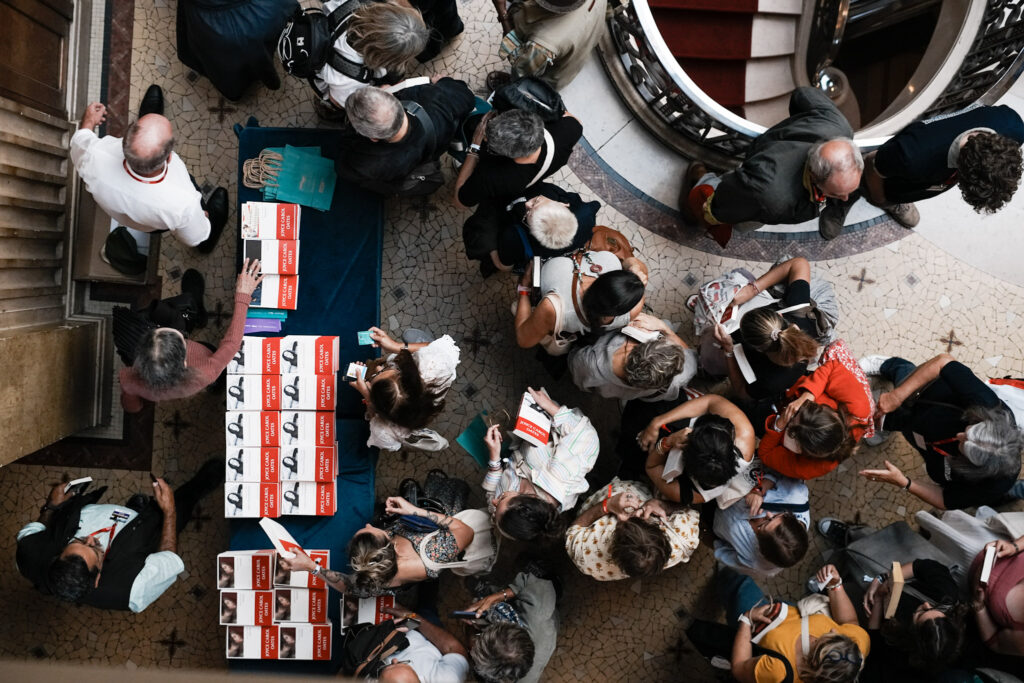
© Siriot de la Petra.
Elsewhere within the bookselling tent, Jake, the proud creator of a title revealed by West Virginia College Press, was already flying by way of e book gross sales. He had simply spoken to a category of teenagers who had mobbed him like a rock star. Once I instructed him about Sébastien, he mentioned, “That man guidelines. I feel he desires us to come back to Corsica.”
An extended queue for Joyce Maynard snaked across the cubicles. I launched myself to 2 girls thumbing by way of books, asking them what they appreciated about American literature. “The tales, the journey, the wide-open areas, and all that,” mentioned the youthful one, who shortly turned her personal questions on me. That they had come right here to study America, and right here I used to be, an actual, stay American. At their prodding, I instructed them about my husband’s work.
“Ah, that wouldn’t exist right here, somebody who writes about being a fisherman,” the girl mentioned. “In France, it’s extra l’institution.”
I requested what she meant by l’institution.
“Professionals,” her companion clarified. “I assumed your husband can be extra like a banker, to be writing about capitalism.”
To know French literature at present, the youthful went on, I ought to think about the girl within the black hat with the crimson lipstick. “She has her personal delusion,” the older lady mentioned.
I’ll confess that at this level, I assumed my French was failing me. The older lady had simply made a degree about le wokisme that I couldn’t fairly observe and, out of worry, didn’t ask her to make clear. However I seemed up the woman with the black hat and crimson lipstick later, and it seems they have been talking about Amélie Nothomb, a Belgian-Francophone novelist with a penchant for sporting massive hats and showing on TV. She was named a baroness by King Philippe.
There appeared to be all types of trendy characters floating across the French literary world. The novelist Rob Franklin instructed me he was on the competition’s opening ceremony when an older lady named Sophie launched herself to him. She was round ninety and putting, with a pixie reduce and an eccentric fashion. Rob had been instructed that his French editor was named Sophie. This lady requested if she may take his image. “I used to be like, ‘Okay, positive. My writer desires to take my picture,’ ” he instructed me. Sophie pulled out a monocle to have a look at her schedule. Then she did a portrait session with him.
The subsequent day, Rob went to satisfy Sophie at his writer’s tent. It was a special lady. He spent the competition questioning who the hell had taken his picture till the final day, when Sophie No. 1 discovered him once more and handed him her enterprise card. It turned out she was France’s most well-known photographer of writers, and she or he’d been doing it for sixty years. “I came upon she’s like … fairly well-known,” he instructed me. On her card was a black-and-white portrait she’d taken of Michel Foucault.
*
There was one particular person I wished to ask concerning the phrase l’institution: Fabienne Gondrand, a literary translator who served as Jake’s interpreter all through the competition. Fabienne had sat beside him on panels, repeating his feedback in French. I instructed Fabienne that a number of folks had used this phrase with me to pinpoint the variations between French and American modern literature. I questioned if she, too, thought American writers have been extra anti-l’institution.
“That’s a little bit reductive,” she mentioned, seeming shocked. She thought maybe the folks I’d spoken to had used that phrase as a result of the competition had executed a superb job curating various voices, similar to nonwhite and Indigenous writers whose works explicitly problem American cultural norms. It occurred to me that I had maybe oversimplified what French readers had meant l’institution to imply. I’d developed a self-serving concept that the writing world consisted of two camps (coastal literati and scrappy Rust Belt writers with jobs) and that in France, everybody acknowledged the latter as superior. That is foolish, when l’institution is so clearly not writers in main metro areas with huge e book offers. L’institution américain, actually, had been invited and declined. I’m speaking about Charles Kushner.
At each version of Pageant America since 2002, Francis instructed me, the U.S. ambassador to France has given a speech on opening evening. Presently, that place is held by Kushner, the real-estate developer and pardoned felon. The U.S. Embassy sometimes forks over a little bit cultural funding for the competition—lower than the Canadian embassy, however not nothing—and this yr they slashed their contribution by 80 %. Francis took this as an indication of mistrust and refused the embassy’s cash altogether.
Francis instructed me that French folks “are feeling a little bit estranged” from the U.S. in the intervening time. Shortly after we spoke, Pageant America distributed a press launch with sharper wording. “Mockingly,” it mentioned, this funding reduce had occurred throughout “the very yr of the 250th anniversary of the Declaration of Independence,” when the competition was internet hosting the most important delegation of American writers ever “in our nation, and sure in Europe or anyplace else.”
The competition is correct to level out the rarity of this delegation, as these writers would hardly ever be grouped collectively. On house turf, they’d extra doubtless be gathered by subject material, identification, or style, as a result of within the U.S., “American” shouldn’t be a uniting descriptor—we’re too near see clearly. However in Vincennes, we will step again and see the entire image. What struck me about French readers was their confidence in their very own style, in the way it may supersede that of most American readers. However French folks have been gazing upon America their complete lives. Once I returned from the competition, I discovered myself in a uncommon second of America gazing again. Kushner’s embassy was advising Individuals to “train warning.” For the reason that competition, pupil protests there have erupted into widespread riots, and I feel we may safely say these have been aimed toward l’institution.
Noelle Mateer is a journalist in Pennsylvania. Her work seems in the Guardian, The Baffler, Wired, and extra.


