


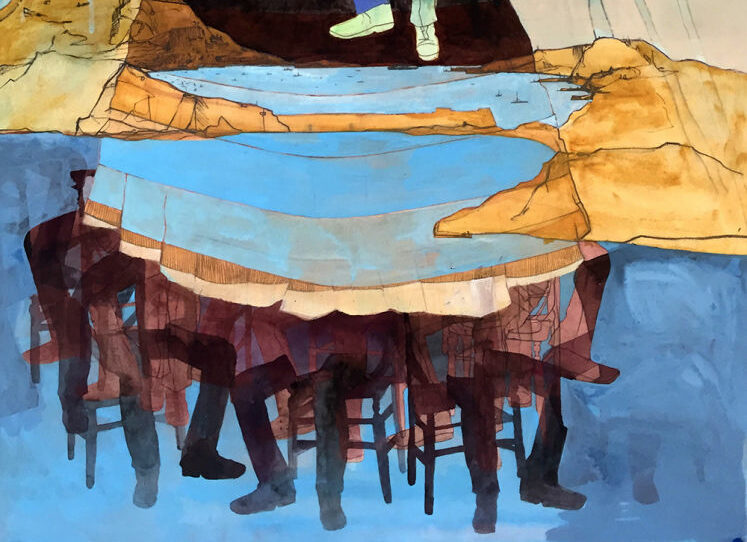
Pamela Phatsimo Sunstrum, Sentinel, 2018. From a portfolio in difficulty no. 232.
Every week, The Paris Evaluate unlocks tales, poems, and interviews from our archive for our readers. This week, we’ve unlocked August Wilson’s Artwork of Theater interview, chosen from the archive by Asha Futterman, whose poem “Examine of Kids” seems in our latest Fall difficulty.
As a highschool pupil, I went on a discipline journey with my largely White class to see a manufacturing of The Piano Lesson, August Wilson’s 1987 play, at Goodman Theatre in Chicago. The central battle of the play is whether or not an ancestral piano carved with the faces of enslaved kin must be offered so as to purchase land. My class carried out monologues from the play for a midterm project, which meant I needed to watch my White classmates yell the N-word of their greatest Black accents again and again. I needed to lookup the plot of the play to explain it precisely, however the reminiscence of my classmates doing their monologues stays stamped in my thoughts.
In Wilson’s 1999 Artwork of Theater interview, George Plimpton and Bonnie Lyons ask the playwright if he thinks it’s a stretch for White audiences to get pleasure from Black theater. Wilson means that it’s, including, nevertheless, “I might assume the white members of the viewers can respect my performs.” This, he says, is “as a result of the specifics and the social manners of the characters, whereas they could be completely different, can actually be acknowledged as a part of human conduct and endeavor.” Wilson’s characters are Black rubbish truck drivers, cooks, and ex-convicts who communicate in timeless, Shakespearean patter. He examines the perceived hole between what’s human and what’s Black, between what’s artwork and what’s Black, between the self and White creativeness. His use of the stage because the setting for this problem is especially poignant—the primary stage on which Black People stood was the public sale block.
When Plimpton and Lyons ask Wilson if he writes to impact social change, he says no. “That’s not why I write,” he says. “I work as an artist. All artwork is political within the sense that it serves somebody’s politics.” It was the viewers, Wilson says, that drew him to playwriting. (He began out as a poet.) “The communal nature of the viewers is like having 5 hundred folks learn your novel and reply to it on the identical time,” he tells the interviewers. “I discover that thrilling.”
—Asha Futterman
INTERVIEW
The Artwork of Theater No. 14
August Wilson
INTERVIEWER
Are you nervous that elements of black tradition are disappearing?
WILSON
No, I discover the tradition sturdy, however I fear a few break in its traditions. I discover it fascinating that within the convocation ceremonies of the traditionally black schools that I’ve attended they don’t sing gospel, they sing Bach as a substitute. It’s within the areas of jazz and rap music that I discover the strongest connection and celebration of black aesthetics and custom. My older daughter known as me from faculty, all excited, and mentioned, “Daddy, I’ve joined the Black Motion Society and we’re finding out Timbuktu.” I mentioned, “Good, however why don’t you research your grandmother and work again to Timbuktu? You may’t make this leap over there to these African kingdoms with out understanding who you’re. You don’t need to go to Africa to be an African. Africa is true right here within the southern a part of the USA. It’s our ancestral homeland. You don’t must make that leap throughout the ocean.”
From difficulty no. 153 (Winter 1999)
Join the Redux e-newsletter to obtain these items in your inbox each Sunday morning.
Asha Futterman is an actor and poet. Her ebook Music of Grey gained the Colorado Prize for Poetry. Her poem “Examine of Kids” seems in our latest Fall difficulty.

