


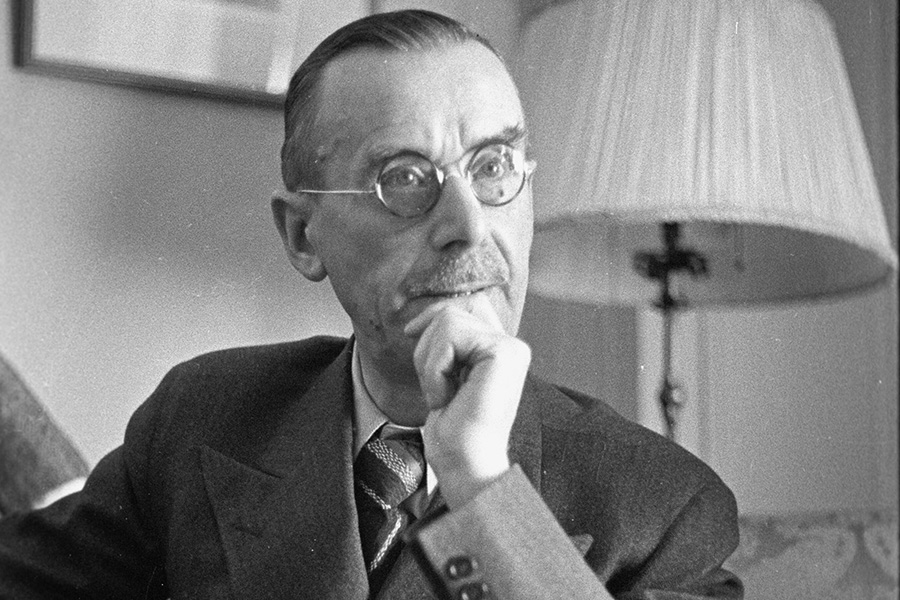
Thomas Mann ca. 1925–1945. {Photograph} by the Los Angeles Every day Information. Courtesy of the UCLA Charles E. Younger Analysis Library Division of Particular Collections.
Colm Tóibín has been writing about Thomas Mann and his household—his spouse, Katia; brother Heinrich; daughters Erika, Monika, and Elisabeth; and sons Klaus, Golo, and Michael—for thirty years. The Irish novelist learn Mann’s first novel, Buddenbrooks, as a young person; in 1996, he was assigned to overview three hefty biographies of Mann for the London Overview of Books, to which he has subsequently contributed nonetheless extra essays on the author.
In 2021, Tóibín revealed his monumental novel The Magician, which recreates in vignette Mann’s childhood in Lübeck, youth in Munich and Italy, worldwide fame as a Nobel laureate, wartime exile in France and america, and dying in Switzerland on the age of eighty. Tóibín’s Mann is a luftmensch of a patriarch, impassively observing his personal drift by way of time when he’s not absorbed by his craft. Der Zauberer, the youngsters name him: the magician. Inscrutable and magnetic, he has the power to make issues seem as if from skinny air.
Earlier this yr, the Polish filmmaker Paweł Pawlikowski’s seventh characteristic, Fatherland, premiered on the Cannes Movie Competition. The movie follows Mann (Hanns Zischler) and his daughter Erika (Sandra Hüller) as they return to a divided Germany after the conflict to just accept the Goethe Prize. Fatherland started as an adaptation of The Magician, although Pawlikowski’s script departs fairly liberally from each the novel and historic reality: notably, it was Katia, largely absent from the movie, who traveled with Mann, somewhat than Erika, who refused to go. Tóibín, who’s thanked within the credit, maintains that there’s “not a line” of his dialogue within the movie, but sure phrasings ring acquainted, as does the tone, a deadpan reckoning with loss, love, and worry. This fall, I known as Tóibín at his dwelling in Los Angeles, the place he wrote a lot of The Magician, to debate the Mann household, exile, and the writer’s enmeshment within the politics of his day.
INTERVIEWER
Seven Palms, the Pacific Palisades dwelling of the Manns from 1942 to 1952, isn’t open to the general public, and but you have been allowed to pay it a go to in your first journey to Los Angeles, in 2005. How did that come about?
COLM TÓIBÍN
I had received the Los Angeles Occasions E-book Prize, however the schlep from Dublin to L.A. for the award ceremony didn’t curiosity me. It’s a protracted journey. I stated to the L.A. Occasions, “Look, if you will get me into Thomas Mann’s home, then I’ll come.” The individuals who purchased the home from the Manns have been nonetheless residing there, although they have been loath to let anybody in. However for some motive, that they had relented simply that week and admitted David Rieff, whose mom, Susan Sontag, was Mann’s visitor there within the forties. They let me in too. It was probably the most fascinating factor to see. That is the home the Manns constructed. This was their refuge. That is the place Physician Faustus was written. That is the examine. That is the kitchen. I used to be already toying with the thought of the e-book at the moment, so it started a technique of visiting the Manns’ homes and drawing quite a lot of power from being in them, and even exterior, trying in on them in Lübeck, in Munich, in rural Bavaria, and notably in Princeton, the place their home is now owned by the Catholic Church.
INTERVIEWER
Have been there any particulars that struck you?
TÓIBÍN
There’s a examine away from the remainder of the home that you may virtually make into somewhat Germany simply by closing the door, obscuring the California mild. What’s very unusual about Mann’s shifting round is that he introduced his desk from Munich—it got here all the best way to Princeton with him after which to California, when the issues of refugees flew within the night time. Actually the Manns’ shifting was achieved in a way more fashionable approach. It’s straightforward to mock the phrase, “Wherever I’m is German tradition,” however by separating his examine from the home and by persevering with his routines there, he was saying, “There may be one one who maintains his decency and connection to custom in the course of all this, and that’s me.”
INTERVIEWER
Was he attempting to stability a need for consolation with a longing for solitude?
TÓIBÍN
He wanted 4 hours within the morning. After that, he wanted home life. Bohemian life and events didn’t curiosity him a lot. He and Katia went for his or her stroll, they could should go someplace within the night, after which they acquired dwelling as rapidly as they may. Their life was centered across the kids coming and going. That they had gardeners, that they had servants—in Munich, that they had a chauffeur. Conserving all that going took quite a lot of time and power.
The query of cash is on the middle of all this. His writer, Alfred A. Knopf, managed to make Mann right into a author whose works each civilized family in America needed to have—and the books offered in huge portions. Physician Faustus was within the E-book-of-the-Month membership.
INTERVIEWER
Generational battle is on the coronary heart of The Magician. For Mann, the son of a senator, pursuing literature was itself a radical prospect. In the meantime, his kids Erika and Klaus, who got here of age within the Weimar period, may specific even their sexuality unabashedly, and overtly dedicated themselves to antifascism early on. May Mann have been jealous of his kids’s sense of liberation?
TÓIBÍN
There’s a really unusual letter from Mann writing them to say, “You’ve all of the enjoyable. I envy the enjoyable you’re having.” His methods of coping with his homosexuality have been so closeted, so unusual, so inward-looking, so framed by his bizarre gaze. There was a wildness in his creativeness that was not matched by his fits.
INTERVIEWER
Certainly one of my favourite elements of The Magician is when W. H. Auden, whom Erika married for British citizenship, and Christopher Isherwood, the “household pimp” who set them up, come to Princeton for a Life photoshoot of the household in 1939. How did Auden and Isherwood really feel about their attachment to the Manns?
TÓIBÍN
Klaus bored them, Erika bored them, and the household bored them. When Auden was requested who probably the most boring author on the earth was, he replied, “My father-in-law.”
I discovered that Life journal problem in some secondhand place. Wanting on the portrait of this household whose daughter married Auden sitting collectively, I may solely suppose, This can be a horrible lie.
INTERVIEWER
Like The Grasp, your 2004 novel about Henry James, The Magician is a deeply researched work of fiction. When endeavor these initiatives, have been you tempted to veer from what really occurred?
TÓIBÍN
You make a pact with the reader. If I say Thomas Mann had six kids, he had six kids. If I say he was not in Germany in 1933, then he wasn’t, and if I say that he went into East Germany along with his spouse in 1949, then he did. So you’re taking that as completely given. I can not intervene with that. However clearly the dialogue is invented. The query then turns into, What type do you do that in? Are you able to write in English a dialogue translated from the German of a century in the past? What is going to that sound like? “The strudel you will have already made twice”? The one factor I may do was to forged it within the English of the twenties, which is sharp, good, with quite a lot of interruptions.
INTERVIEWER
Did you will have a mannequin for that?
TÓIBÍN
Hemingway’s Girl Brett Ashley. There are moments when Erika particularly—but in addition Katia—talks in that completely good approach, as if she’s acquired a cigarette in a single hand and a pink hat on, saying issues sharply. Whereas Mann barely speaks within the e-book. There’s a continuing withholding on his half—a reticence, a tact, but in addition, he’s not given to talking his thoughts. There are not any massive paragraphs of dialogue. My purpose is to immerse the reader on this world, this thoughts, this presence, this room, to create the phantasm that you’re there, which is what a novelist does in any case, wherever. Info—or information—doesn’t curiosity me, nevertheless it must be there as a result of I’m naming him, it’s his title. As soon as I exploit his title, the pact must be made.
INTERVIEWER
Biographers have instructed that Mann wrote Loss of life in Venice partially, as a approach of “popping out” to his brother. Was Mann merely repressed or did he take some pleasure in stretching the boundaries that he set for himself?
TÓIBÍN
Is Aschenbach Thomas Mann? Sure, in some senses, nevertheless it’s additionally as if Mann is saying, “What enjoyable we’re having, enjoying with our internal secret selves, shedding mild on sure issues and never others.” It’s virtually a joyful sport.
This query arose once I went to Germany with the e-book. On the Frankfurt E-book Honest, I used to be interviewed by a younger journalist from the Frankfurter Allgemeine Zeitung whose first query was, “How does it really feel queering Thomas Mann?” I answered, “Effectively, I didn’t write Loss of life in Venice. I didn’t write the diaries.” Mann’s goals have been homoerotic! His spouse was maybe lucky in that he by no means checked out one other girl in his life… I bear in mind saying to my German editor, “It’s in Physician Faustus.” It’s the identical on the finish of Buddenbrooks, the place Hanno has this younger man. It’s there, hiding in plain sight, on a regular basis. However some couldn’t countenance how an important nationwide hero, a determine who represented decency in a time when there was none, is also somebody who hid his sexuality. I discovered loads about Germany as a rustic from that have, that there are issues it nonetheless hasn’t handled, considered one of them being homosexuality.
INTERVIEWER
Eleven years after Mann’s son Klaus revealed his most well-known novel, Mephisto, Mann introduced out a Faust story of his personal. Klaus killed himself two years later. Do you suppose Klaus took Physician Faustus as a betrayal?
TÓIBÍN
It’s the Oedipus complicated turned the opposite approach round, isn’t it? You need to kill your son so you possibly can sleep with—who? It’s extraordinary that when Mann comes to jot down his massive e-book dramatizing what has occurred in Germany, he cites the Faust fable within the very title: Klaus’s Mephisto turns into Mann’s Physician Faustus. I believe he did it not intentionally, however carelessly. It simply didn’t hassle him. Mephisto was banned in Germany even into the sixties—the e-book had an terrible afterlife—whereas Physician Faustus was introduced to the world as the nice e-book you needed to examine music.
INTERVIEWER
Why did Mann insist on travelling to Germany in 1949—so quickly after Klaus’s dying—regardless of having vowed only a few years prior by no means to return?
TÓIBÍN
From Goethe Mann acquired the concept he lived in language. He was writing his books at a degree when there was no chance of their being revealed in German, so the language turned this secret factor he introduced throughout the Atlantic that he had in his examine. His level was that the language had no border. But it surely’s a really silly level. Sure phrases shall be used within the East and the West in numerous methods.
And but, he didn’t need Brecht or his brother Heinrich to name him a stooge if it was recognized that he had complied with the Individuals’ want that he not go into the East. Brecht having one other weapon towards him would have been terrible for Mann, who’d been in such opposition to those folks in California. So he went, and that was the top of his time in America. The American authorities was making ready to deport Erika, who had neither citizenship nor a inexperienced card. If she was going to have to go away, her dad and mom would go together with her. They hadn’t actually deliberate for this, however the alternative arose, so Mann drifted into taking it.
We have now to recollect how a lot drift issues to a novelist, how a call you didn’t make, after which ended up getting cussed about, leads you to do one thing fully silly.
INTERVIEWER
This was a sample in Mann’s life. Throughout World Conflict I, he spoke up, however his stance was out of contact. He didn’t formally repudiate Hitler till 1936, and solely after Erika threatened to interrupt contact. Even then, it was Katia who drafted his assertion. Mann saved getting thrust onto the world-historical stage, however every time, he hesitated to take a coherent place.
TÓIBÍN
In 1942, he begins to speak in regards to the future. His speeches throughout America, given with Roosevelt’s approval, are on the approaching victory of democracy. He’s not saying Germany is doomed and have to be cemented over to offer brussels sprouts for the remainder of Europe, which was the Morgenthau Plan. He’s saying, “There may be constructed into German tradition an thought of democracy that may flourish, I promise you this.” There have been about two or three years when he was virtually a political thinker.
INTERVIEWER
After the conflict, Erika was working as Mann’s secretary and accompanied him virtually all over the place. Why didn’t she go to Germany with him?
TÓIBÍN
Erika was irascible, and he or she was severe about her politics. The notion of being paraded round West Germany together with her father on the Manns’ return to Germany, realizing how many individuals had been restored to their former positions, being interviewed on a regular basis, and having to say, “This isn’t what we imagined would occur after the conflict”—there have been so many causes to not go.
INTERVIEWER
Klaus went again to Germany and was disgusted to see Erika’s first husband, Gustaf Gründgens, who’d been a star of the Nazi theatre, carry out to a standing ovation.
TÓIBÍN
At midnight, they will applaud.
INTERVIEWER
Mann lived to see the rise and fall of fascism, the resurgence of which has renewed widespread curiosity in him. Is there something that we will study from Mann’s expertise of his period?
TÓIBÍN
One wonders how this smart determine who appeared embedded in German tradition couldn’t have seen Hitler coming—in the identical approach that any variety of folks we’d care to say couldn’t see Trump coming. It appeared a daft chance. However what’s essential for me is the truth that he modified. Watch Thomas Mann in 1914 and see how onerous his politics have been: he was not a democrat, he was a monarchist. The distinction between Reflections of a Nonpolitical Man and the speeches he’s making in 1942 are what’s actually value taking a look at, the nice change that befell in his politics.
INTERVIEWER
In any case of this time studying, writing about, and inhabiting the thoughts of Thomas Mann, is there something that also mystifies you?
TÓIBÍN
It’s fascinating that he wanted to maintain the diaries and write Loss of life in Venice. He wanted to be recognized, to be seen. What an attention-grabbing thought for somebody who was so good at being invisible.
Andrew Marzoni is a author, editor, and musician.

