


Simply north of Paris, within the département of the Oise, the Château de Pierrefonds appears to be like like a fairy-ale citadel – however virtually nothing about it’s fairly what it appears. Constructed, destroyed, deserted and finally remodeled into the spectacular château you see right now, it is stuffed with unusual particulars and surprises that can bewitch you. You may simply should take a better look.
The Château de Pierrefonds looms above the village of the identical identify like a benevolent medieval large, all turrets and towers watching over it residents. If you happen to have been a baby, that is the citadel you’d draw when dreaming about knights and princesses.
It appears to be like so totally medieval that you simply may assume it has stood right here for hundreds of years, roughly as you see it right now.
You’ll be fallacious.
Pierrefonds is medieval, however additionally it is a Nineteenth-century creation. It was constructed centuries in the past, destroyed, left to turn out to be a romantic break, after which reconstructed by the architect Eugène Viollet-le-Duc for Napoleon III.

My information throughout the château’s go to, Charlene Goffart, made a remark that immediately targeted how I’d see this citadel: “La malédiction de Pierrefonds, c’est qu’il ne sera jamais habité.” The curse of Pierrefonds is that it’s going to by no means be inhabited.
Not actually, after all. Loads of individuals occupied the positioning at varied instances. However those that dreamed of creating Pierrefonds a grand residence by no means received to take pleasure in it as they’d deliberate. Historical past saved interrupting them.
NOTE: Pages on this website could comprise affiliate hyperlinks, which help this website. See full Privateness Coverage right here.
Louis d’Orléans builds Pierrefonds
All of it started with Louis d’Orléans, youthful brother of King Charles VI.
In 1393, Louis acquired the duchy of Valois as an appanage, a grant of territory and its revenues awarded to a member of the royal household. He ordered the constructing of a fortified residence at Pierrefonds, the place an earlier fortress already stood.
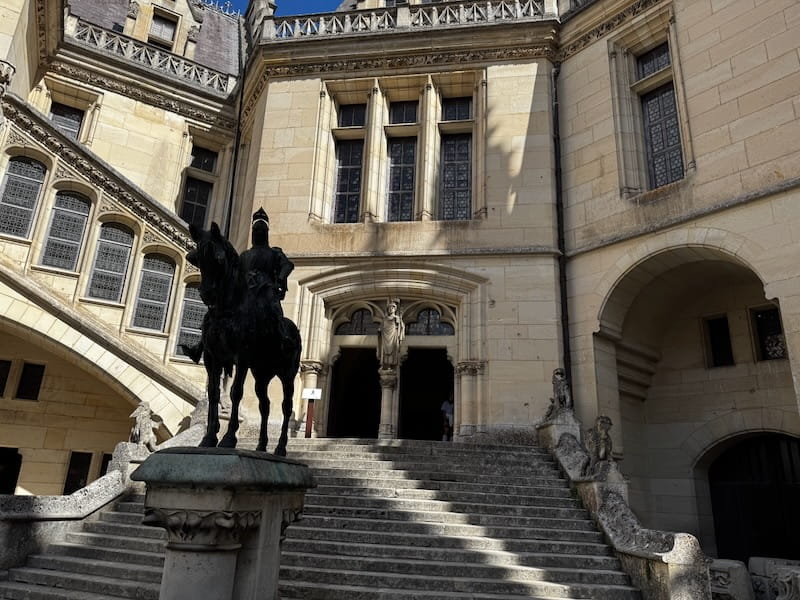 Louis d’Orléans sits proudly on his horse at Pierrefonds’ entrance ©OffbeatFrance
The situation made sense strategically: Pierrefonds might shield the routes that led to the Duke of Burgundy’s territories – Louis was in rising competitors with the duke, Jean sans Peur, who additionally occurred to be his cousin. Pierrefonds would additionally enable him to keep watch over the important thing roads north towards Flanders.
Charles VI suffered durations of extreme psychological sickness and was typically unable to rule, leaving Louis and Jean competing for management of the federal government in a wrestle that turned more and more violent.
Louis would solely get so far as the château’s footprint – he established the foundations and the citadel’s primary measurement, however he would by no means see the constructing of the snug residences a prince would wish to make this into a correct residence. In 1407, Jean had Louis assassinated within the streets of Paris, leaving the citadel at Pierrefonds unfinished.
The Burgundian duke would later assault Pierrefonds and burn a part of its roof.
So the person who constructed it by no means accomplished it, and the person who had him murdered helped injury it. The curse had begun.
Louis XIII and the destruction of Pierrefonds
Pierrefonds remained within the palms of the royal household after Louis d’Orléans’ homicide, finally ending up within the palms of Antoine d’Estrées, father of Gabrielle d’Estrées, the well-known mistress of Henri IV. When Antoine died in 1609, the château handed to his son, François-Annibal d’Estrées.
When Henri IV was assassinated in 1610, his younger son turned Louis XIII, along with his mom, Marie de Médicis, governing as regent till he got here of age. François-Annibal d’Estrées was a part of a bunch of nobles who challenged the rising energy of the crown, making Pierrefonds a possible stronghold for these against the king.
In 1617, royal troops attacked the château, and inside weeks Louis XIII ordered it dismantled: the flooring and roof buildings have been burned and the towers break up open.
 Louis XIII, King of France by Balthasar Moncornet c. 1600 – 1668 Nationwide Gallery of Artwork
However Pierrefonds was not razed: its ruins have been intentionally left standing, a transparent royal message to different recalcitrant nobles – that is what occurs to a fortress when its proprietor opposes the crown.
Pierrefonds, now derelict, remained this fashion by the seventeenth and 18th centuries, with native individuals serving to themselves to the free constructing supplies.
However the pile of stones was additionally changing into one thing else: it was changing into picturesque.
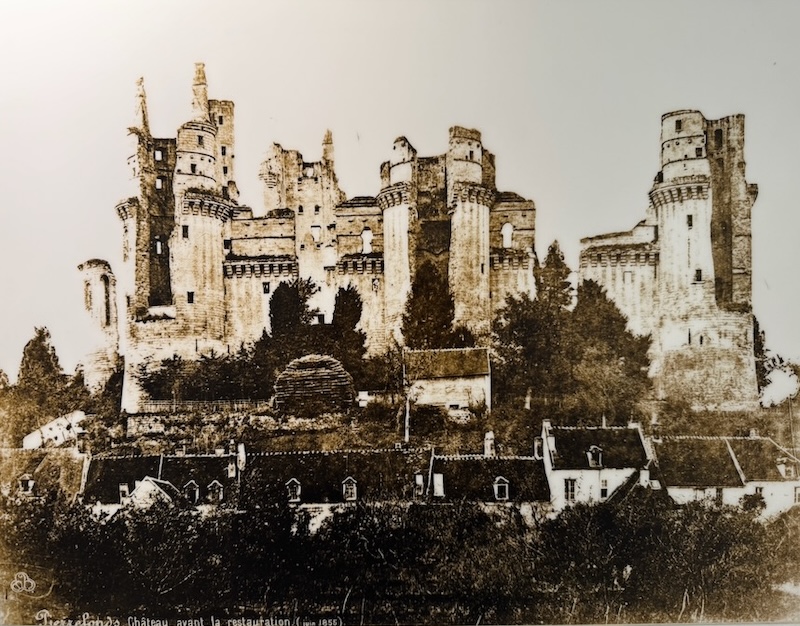 Historical picture of Pierrefonds in ruins
Romantic Pierrefonds
By the Nineteenth century, Pierrefonds was very a lot in style.
Romanticism had sparked a style for medieval ruins, which individuals seen as atmospheric reminders of the previous, a lot because the nostalgia many people expertise right now. Artists and guests flocked to the château, poking by what was left.
The vacationers included Alexandre Dumas, who got here from his residence in close by Villers-Cotterêts, and Pierrefonds seems in The Three Musketeers, the place Porthos is given the title of Seigneur de Pierrefonds. Even Louis-Philippe, who can be the final king of France, used the ruins for a grand event, holding his daughter’s marriage ceremony there.
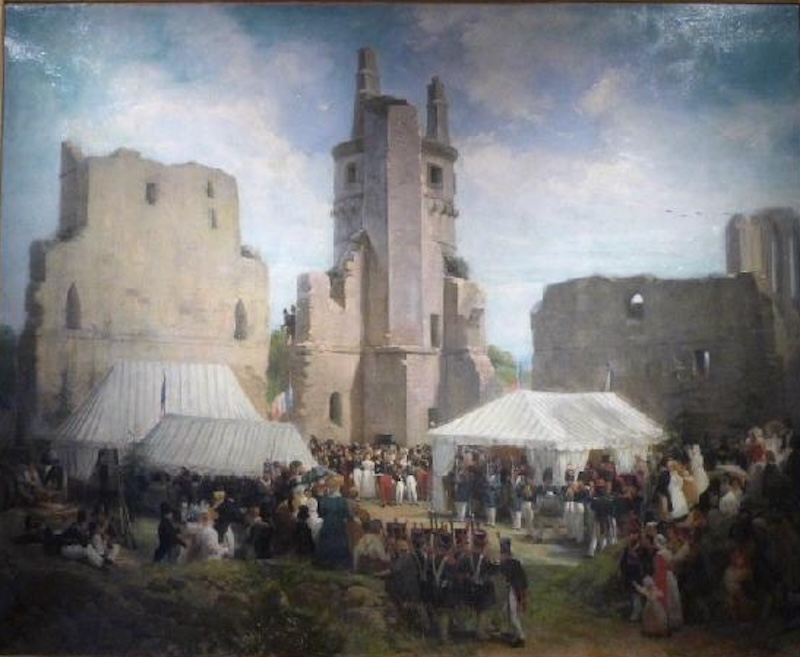 Louis-Philippe and his household at Pierrefonds. Portray by Féron Éloi Firmin (1802-1876). Musée des Beaux-Arts, Excursions
After which somebody got here up with a superb concept: they put in harpes éoliennes, or wind harps, within the surviving towers. Picket bins fitted with strings have been positioned within the outdated openings and when the wind handed by them, the strings vibrated and produced an odd, melancholy sound, virtually haunted. This attracted much more individuals.
Quite than a functioning medieval fortress, Pierrefonds had been remodeled right into a romantic relic – and that was exactly what made it engaging. Napoleon I finally purchased it, however did not restore it, additionally having fun with the picturesque attraction it exercised on artists and guests.
Pierrefonds’ actual transformation would happen below his nephew, Napoleon III.
Napoleon III decides to rebuild
Round 1857, Napoleon III determined to carry Pierrefonds again to life, initially as a retreat close to his favourite imperial residence at Compiègne.
He had already visited the ruins just a few years earlier, earlier than changing into emperor, and had been enchanted. As soon as topped, he determined to revive Pierrefonds and consulted Prosper Mérimée, the author and inspector of historic monuments, who really helpful Eugène Viollet-le-Duc for the job.
Viollet-le-Duc was already one in all France’s main consultants on medieval structure. He had labored on main Gothic restoration initiatives and had already written about Pierrefonds. He wasn’t only a builder introduced in to restore an outdated citadel however an architect with very particular concepts about medieval structure.
WHO WAS VIOLLET-LE-DUC?
Eugène-Emmanuel Viollet-le-Duc (1814–1879) was the Nineteenth-century architect behind a few of France’s most well-known medieval restorations. He labored on the restoration of Notre-Dame de Paris and the medieval metropolis of Carcassonne, amongst many different monuments.
His strategy was controversial: he didn’t all the time restore buildings precisely as they’d been, however typically reconstructed the medieval structure he believed ought to have existed. Pierrefonds is one in all his most bold examples.
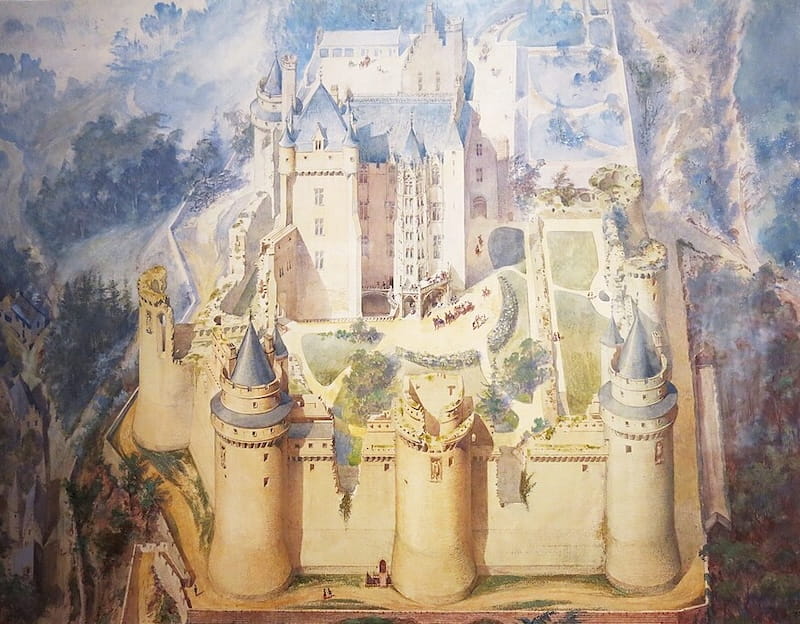 Viollet-le-Duc’s 1858 plan for the restoration of Pierrefonds
Early plans have been comparatively restrained and Viollet-le-Duc was initially requested to revive the donjon – the primary fortified tower – and two nook towers, leaving the remainder of the Romantic ruins as they have been.
The restored part was supposed as a relais de chasse, basically a searching lodge. Guests might hunt within the close by forest of Compiègne and cease at Pierrefonds afterward.
Ultimately, Napoleon III determined to go all in and switch the complete citadel into an imperial residence. Viollet-le-Duc was in all probability ecstatic.
Viollet-le-Duc’s reconstruction
Because the medieval citadel had by no means been accomplished, there was no last constructing to breed: the architect must “embellish”, creating his imaginative and prescient of a perfect medieval fortress and utilizing Pierrefonds as a type of laboratory for his concepts.
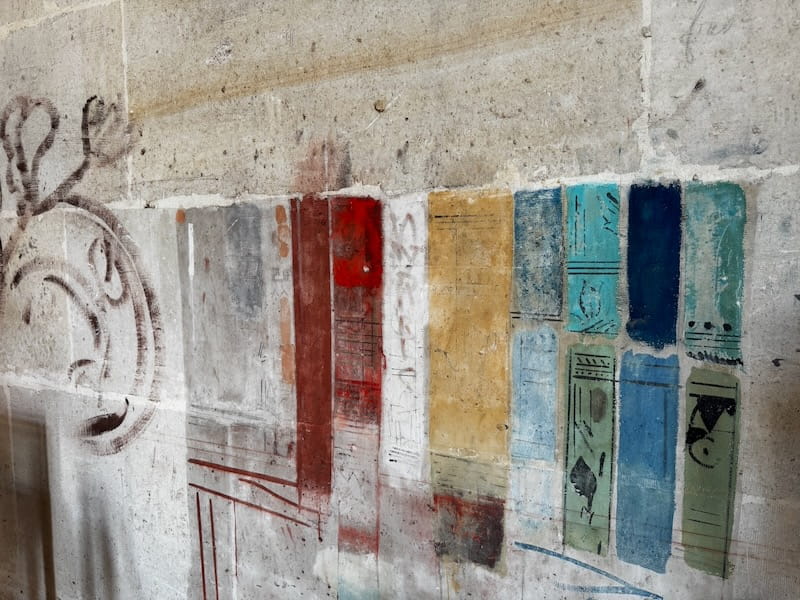 This shade chart offers us a peek into Viollet-le-Duc’s creativity – it’s a stunning leftover and would usually have been painted over had Pierrefonds been accomplished ©OffbeatFrance
That is exactly why if you stroll by Pierrefonds, you’re strolling by each the Center Ages and the Center Ages as imagined by Viollet-le-Duc.
And all over the place you look, you will assume your eyes are taking part in tips on you.
A number of the stones actually are medieval; others are from the Nineteenth century. Some options reproduce what Viollet-le-Duc discovered; others are totally his invention. Chances are you’ll be hard-pressed to inform the distinction.
After which there are the monsters, the chimères, or hybrid creatures: a unicorn, a mermaid wanting right into a mirror, a creature with an unlimited beak and an escargot perched on it, and one other with a lady’s head and the physique of a dragon or lizard.
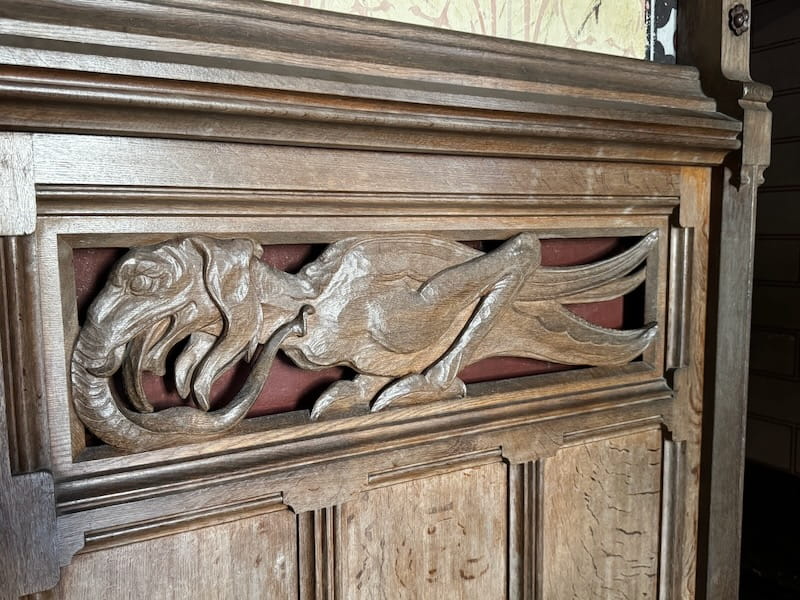 It is unattainable to know what may need been going by Viollet-le-Duc’s thoughts as he designed this birdlike reptile ©OffbeatFrance
The courtyard alone has greater than 250 ornaments.
You may discover 32 felines – cats or cat-like gargoyles or chimera – on the dormer home windows, one supposedly representing Viollet-le-Duc’s personal cat. He could have determined that his pet belonged in his best medieval world, too.
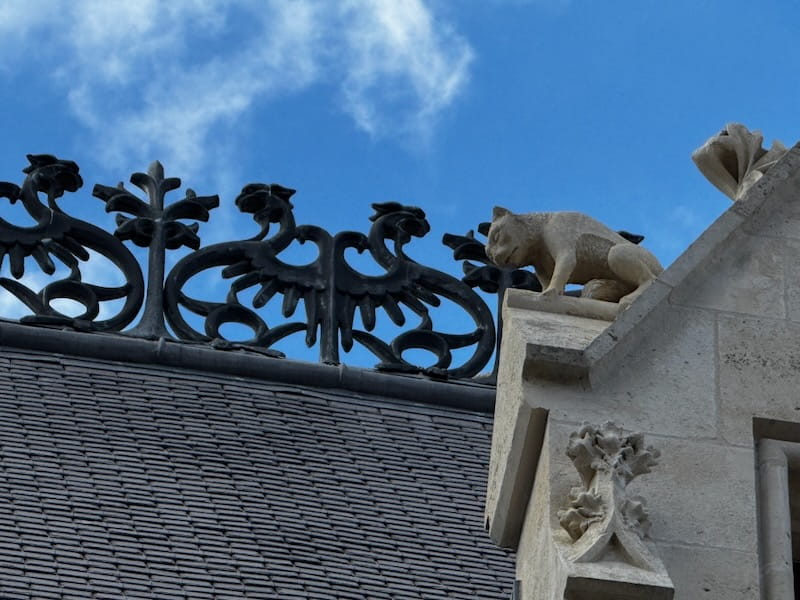 One of many many sculpted cats alongside the citadel roof. Might THIS be Viollet-le-Duc’s personal pet? ©OffbeatFrance
The visible tips proceed inside.
The monumental staircase resulting in the grand corridor of the Salle des Preuses is intentionally spectacular, designed to impress guests approaching the nice reception room.
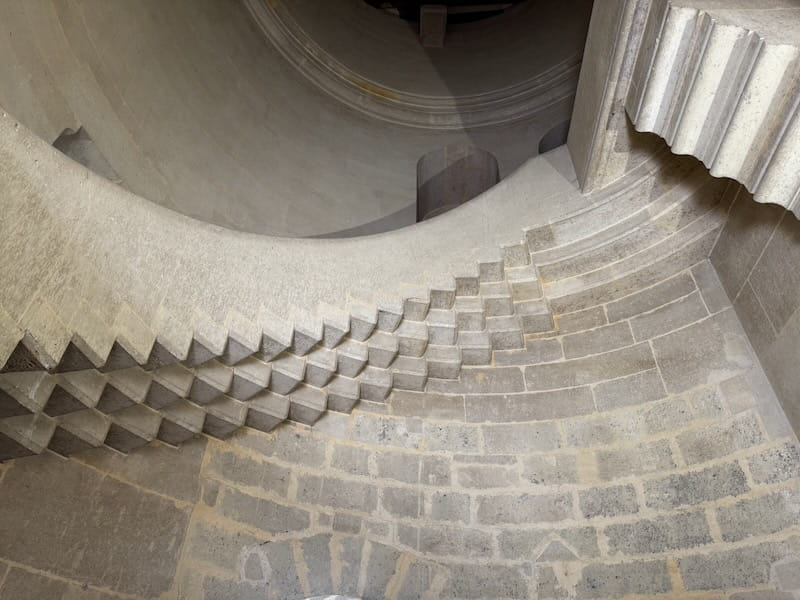 The monumental staircase, which appears to be like stunningly fashionable ©OffbeatFrance
There’s additionally a double staircase, with two separate flights in order that troopers and company might use completely different routes, probably to maintain drunken troopers away from girls sporting their monumental Nineteenth-century crinolines.
Not like the Chambord staircase, which dominates the château’s central design, Pierrefonds’ double-stairway is tucked into the constructing and has a sensible use in addition to an ornamental one.
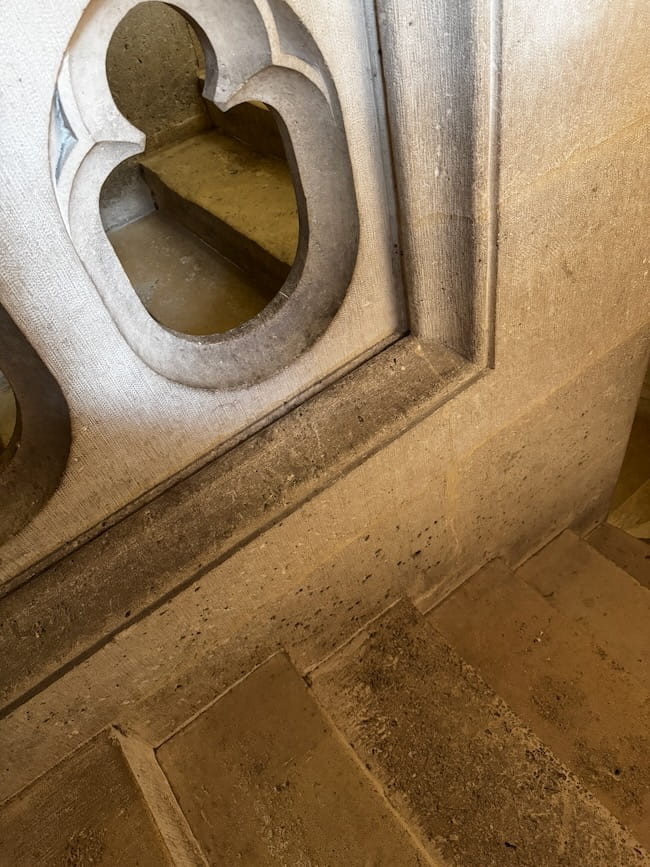 As you go down on the correct, you will not be capable to determine who’s arising on the left ©OffbeatFrance
My one remorse at Pierrefonds was being unable to go to the Salle des Preuses as a result of its work have been being restored. I requested if I might take a peek however because the work comprise lead, a significant safety protocol was in place, involving masks, clothes adjustments and showers.
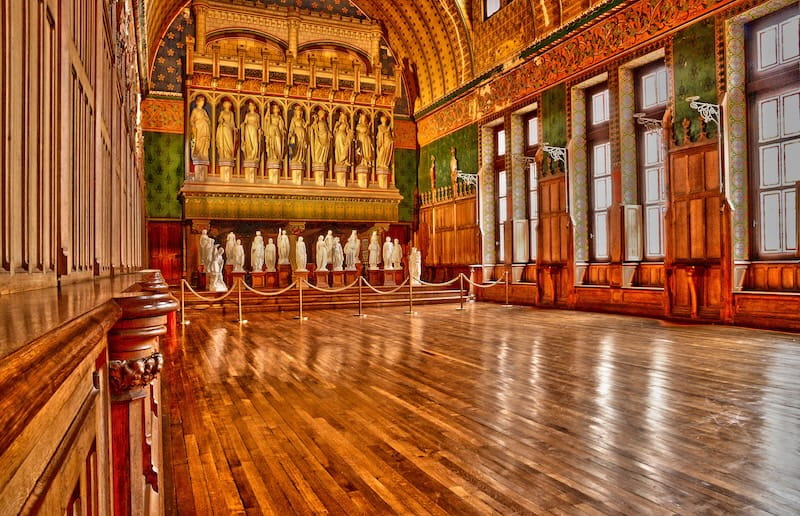 The Salle des Preuses, because it ought to look subsequent time I go to: 52 m lengthy (170 ft) and 12 m (39 ft) excessive
However we weren’t utterly bereft – the château designed a small-scale facsimile of this grand room in order that we might get closeups of its statues, the 9 Preuses, feminine counterparts of the medieval Neuf Preux, or 9 Worthies.
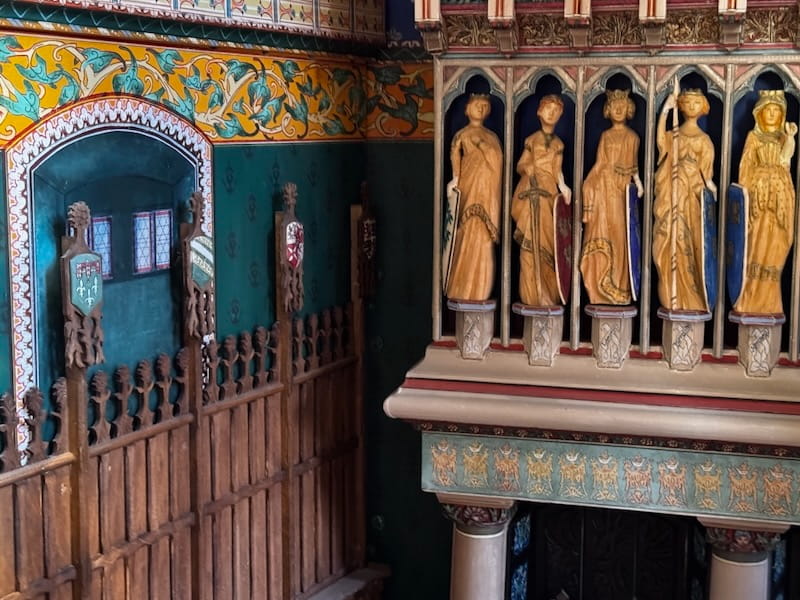 That is a part of a small mannequin of the Salle des Preuses, which has been below restoration ©OffbeatFrance
After which there are the squirrels.
No one is sort of positive why they’re there. There’s a principle involving the heraldry of Louis d’Orléans, however nothing particular.
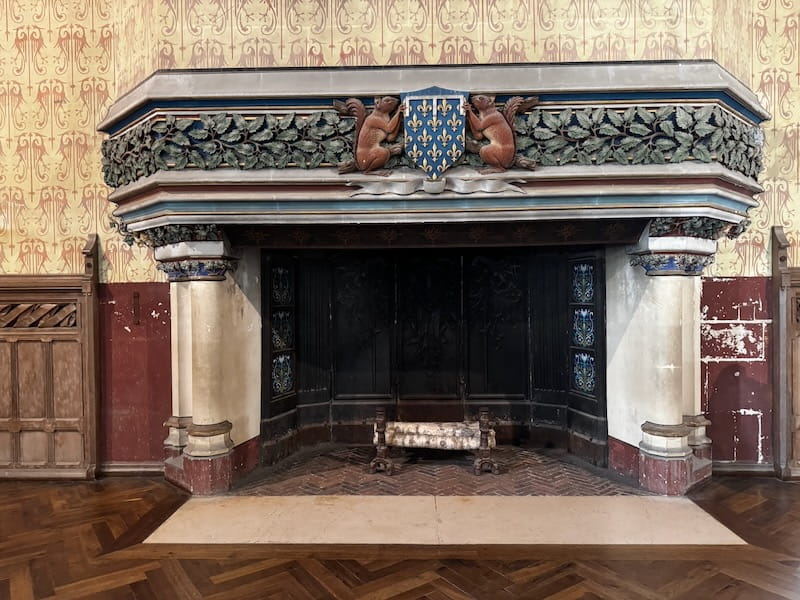 The function or which means of those squirrels is not recognized. Right here, they’re subsequent to Louis d’Orléans coat of arms. Observe the M-like silver bar alongside its higher edge – that symbolizes royal kinship, as in sibling, ancestor or descendant of a king ©OffbeatFrance
One in every of Pierrefonds’ most spectacular surprises is downstairs, out of sight.
This cavernous house is a part of Louis d’Orléans’ medieval citadel, though Viollet-le-Duc altered it throughout his Nineteenth-century restoration. Right this moment it’s full of 96 gisants, or recumbent funerary sculptures. They’re plaster casts, not medieval tombs: Louis-Philippe commissioned them in 1833, however they solely made it to Pierrefonds within the early Fifties. Amongst them are figures comparable to Catherine de Médicis, Louis XII, Louis d’Orléans and Richard the Lionheart.
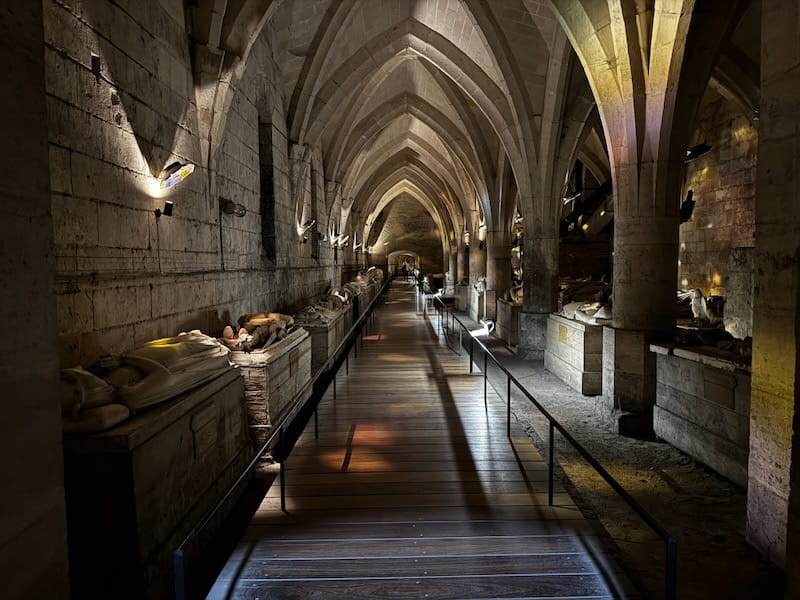
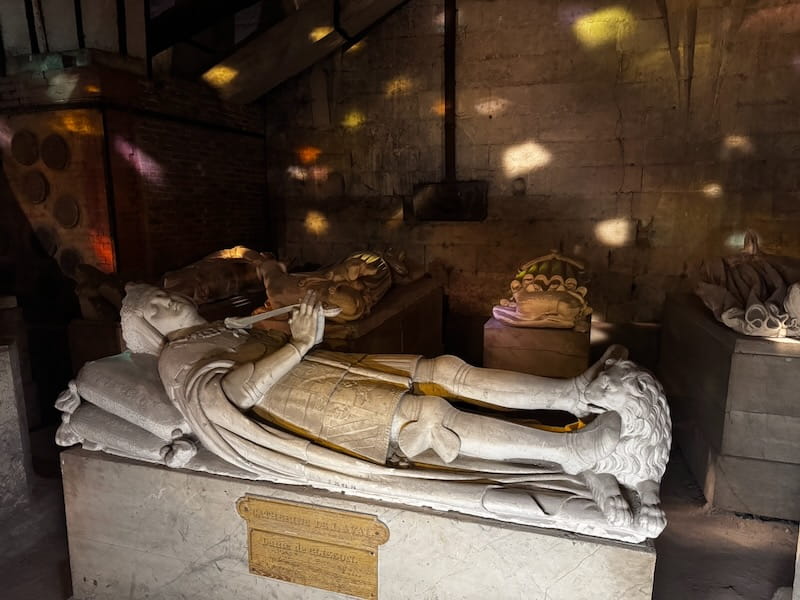 High: the citadel’s outstanding crypt; above: a closeup of one of many “gisants” ©OffbeatFrance
So even right here, Pierrefonds is mixing the centuries: medieval stone, a Nineteenth-century restoration and a set of Nineteenth-century casts that solely arrived within the twentieth.
Napoleon III’s imperial residence
Napoleon III’s château was designed as an imperial residence and its residences have been adorned accordingly.
Imperial symbols are all over the place: Napoleon I’s imperial bee makes just a few appearances, however Napoleon III’s imperial eagle and N are way more prevalent.
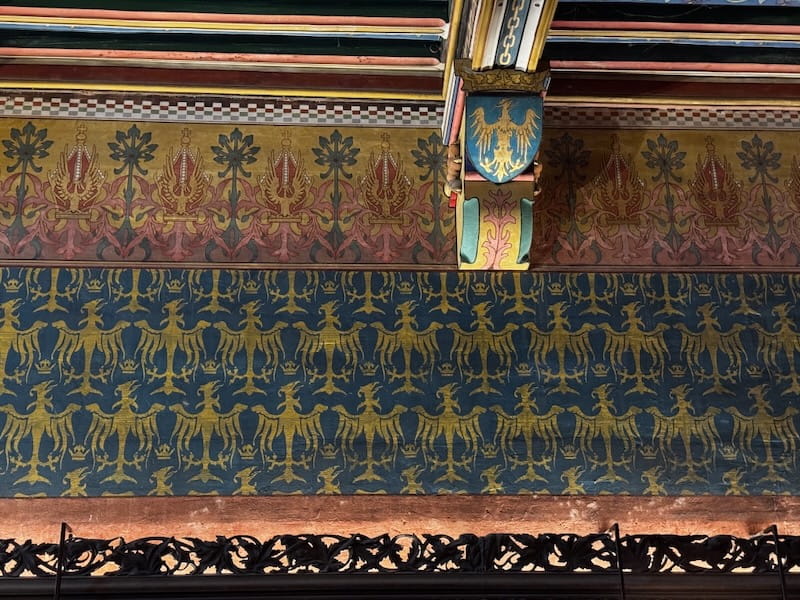 Imperial eagles, Napoleon III’s image – on the wallpaper but additionally on the wood cornice close to the ceiling ©OffbeatFrance
Eugénie’s rooms have thistles, a reference to her Scottish ancestry, together with flowers, birds and different pure motifs. The ornament additionally brings within the medieval world of Louis d’Orléans and the legends of King Arthur.
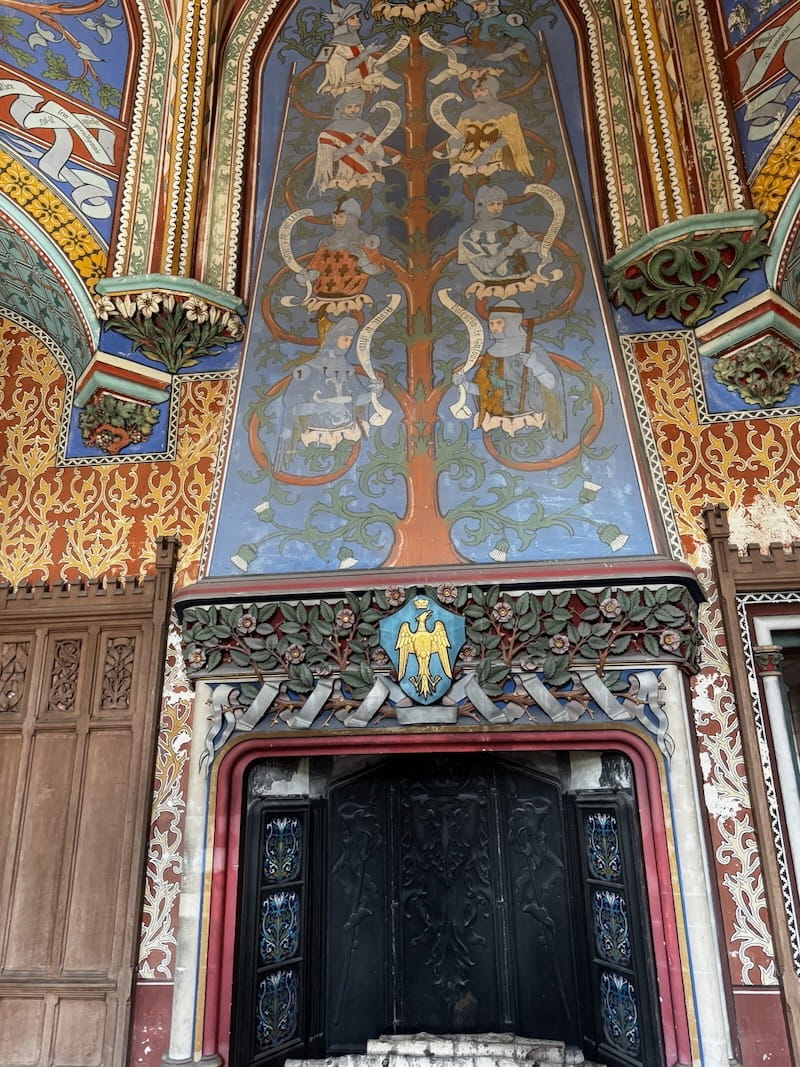 A part of the frilly decor of Eugénie’s room, with a tall portray referencing King Arthur above the fireside (and naturally an imperial eagle) ©OffbeatFrance
All through the citadel, you will discover the startling distinction of completed vs unfinished. At instances, intricately painted ceilings sit atop naked stone partitions, ready for a decorator’s hand to use its magic.
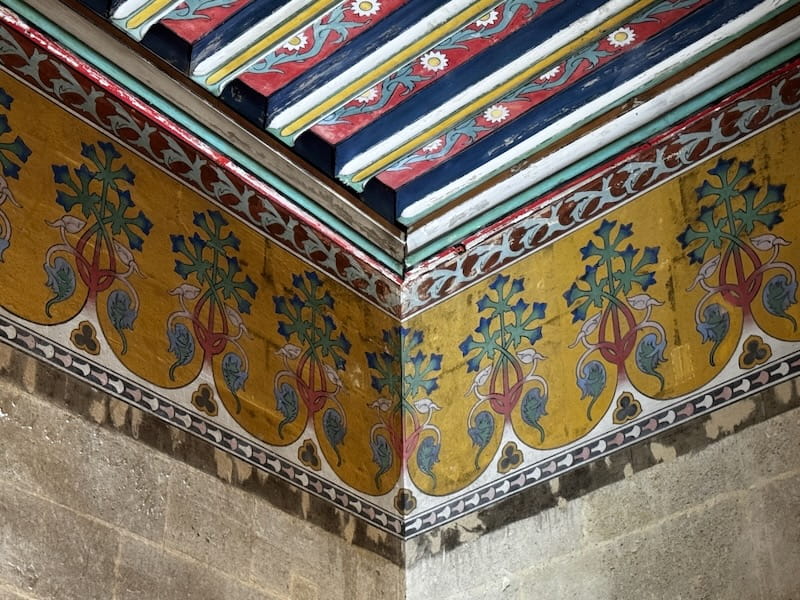 A lot of Pierrefonds’ ceilings have been painted however renovations usually did not make it so far as the partitions ©OffbeatFrance
At one level, Napoleon III determined to show a part of Pierrefonds right into a museum, exhibiting his assortment of medieval armor and weapons.
The museum attracted guests who got here partly to see the collections and partly to see the big restoration mission in progress.
Regardless of all of the work, Napoleon III, Eugénie and their son would by no means spend an evening at Pierrefonds.
The top of the Second Empire
All the things floor to a halt when in 1870, France was defeated within the Franco-Prussian Struggle and the Second Empire of Napoleon III collapsed. Reconstruction did not cease, however the state finances was drastically reduce, from round 20 million of right now’s Euros to about three million.
Viollet-le-Duc himself died in 1879, earlier than he might full the work, which was taken over for just a few years by his son-in-law and successor, Maurice Ouradou.
Ultimately, the person who had been given the prospect to create his best medieval citadel by no means noticed his whole mission completed.
However Pierrefonds was altering in different methods, too.
With its a number of thermal springs, the village finally turned a trendy spa city till World Struggle I, often called Pierrefonds-les-Bains. You may see the legacy of that interval in its aristocratic houses and Belle Epoque structure.
PRACTICAL INFORMATION
- Getting there: You may attain Compiègne, the closest prepare station, by prepare from Paris in below an hour. From Compiègne you may catch a bus to Pierrefonds, together with from the railway station.
- Getting round: There is a unbelievable biking infrastructure all through the Oise and you’ll simply trip from Compiègne to Pierrefonds in an hour on gravel paths by the gorgeous forest. The native vacationer workplace in Compiègne has loads of biking data, or you may test the Oise vacationer website and obtain maps from there (website in French).
- How lengthy do you want? The château itself requires two hours so when you’re coming from Compiègne, schedule half a day and find time for lunch.
- Find out how to go to: You may discover Pierrefonds independently with a free English-language customer description, be a part of a free guided tour (often in French) at set instances, or lease an audioguide in English. Pierrefonds is on a hill, with loads of uphill strolling, and there aren’t any elevators inside.
- The place to remain: Pierrefonds has various visitor homes if you would like to remain within the village, or you may keep within the a lot bigger Compiègne (examine costs right here).
- The place I ate: I had a beautiful lunch on the Chalet du Lac, proper on the water with a unbelievable view of Pierrefonds’ “different” chateau and good native and conventional dishes. You must also drop by the Charcuterie Bigot throughout the sq. and attempt to take some residence – they’ve received each prize possible!
- Finest for: vacationers serious about historical past, structure and weird castles.
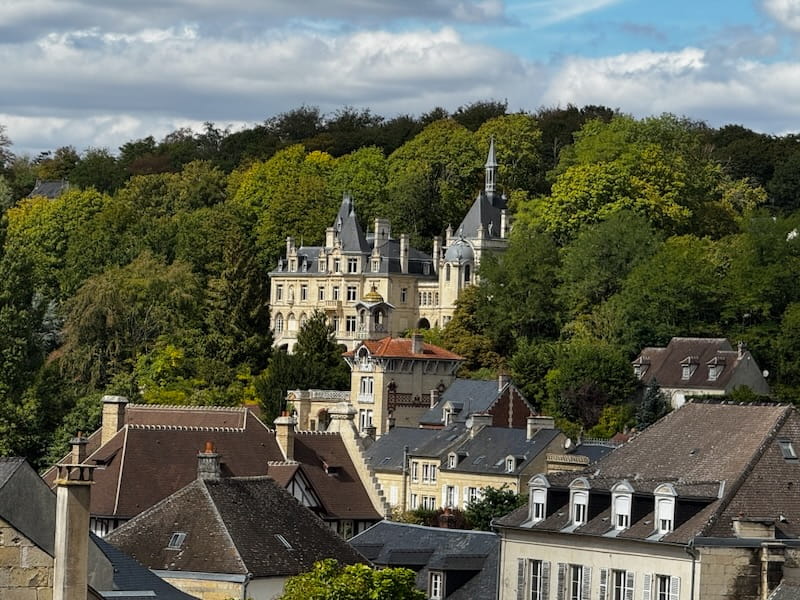 You may see the wealth of this city in its buildings. Within the distance the Château de Jonval, a personal residence ©OffbeatFrance
So what do you assume? Is Pierrefonds actually cursed?
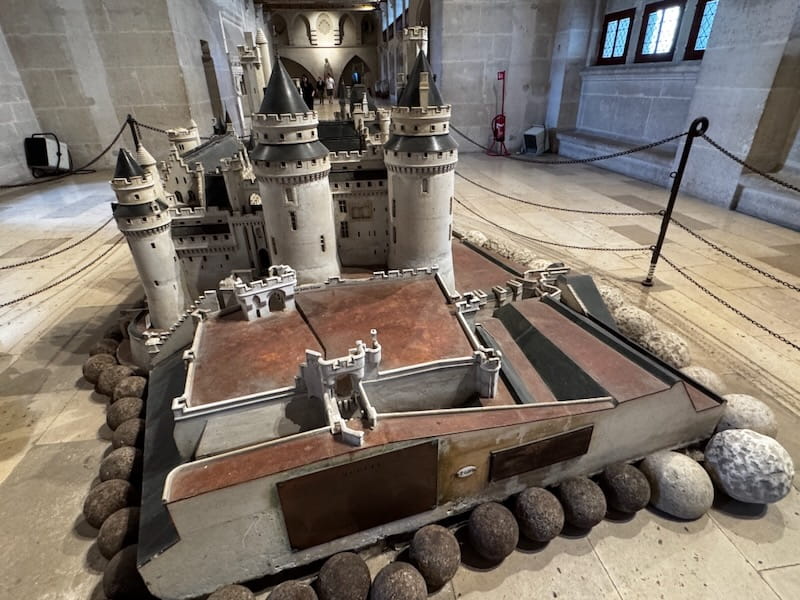 This stone mannequin of Pierrefonds offers a wonderful aerial view of the citadel ©OffbeatFrance
Maybe not within the supernatural sense, however you need to admit it has amassed an unusually convincing file of plans that went fallacious:
- Louis d’Orléans constructed it and was murdered earlier than it was completed
- then it was caught up in political battle
- Louis XIII destroyed it
- for generations, it stood as a break
- then Napoleon III determined to show it into an imperial residence, however his empire fell earlier than he might sleep there
- and Viollet-le-Duc himself died earlier than he might see the work completed.
And but Pierrefonds not solely survived, however turned a monument to an concept of the Center Ages, a stunning, outstanding work of structure. It’s usually used as a backdrop for motion pictures – there is a cause it is nicknamed “Merlin Citadel” (from the BBC tv sequence Merlin, which used Pierrefonds as Camelot, King Arthur’s citadel).
So whereas the château could not have been significantly profitable as a residence, it succeeded spectacularly as a spectacle. The “curse” simply offers it with that little additional frisson.
 An imposing view of Pierrefonds citadel ©OffbeatFrance
Earlier than you go…
As soon as you have explored the château, do not miss close by Compiègne, with its personal extraordinary historical past, from royal searching events to the Second Empire – and, a lot later, the signing of the 1918 Armistice.
Did you take pleasure in this text? I might love when you shared it!

