



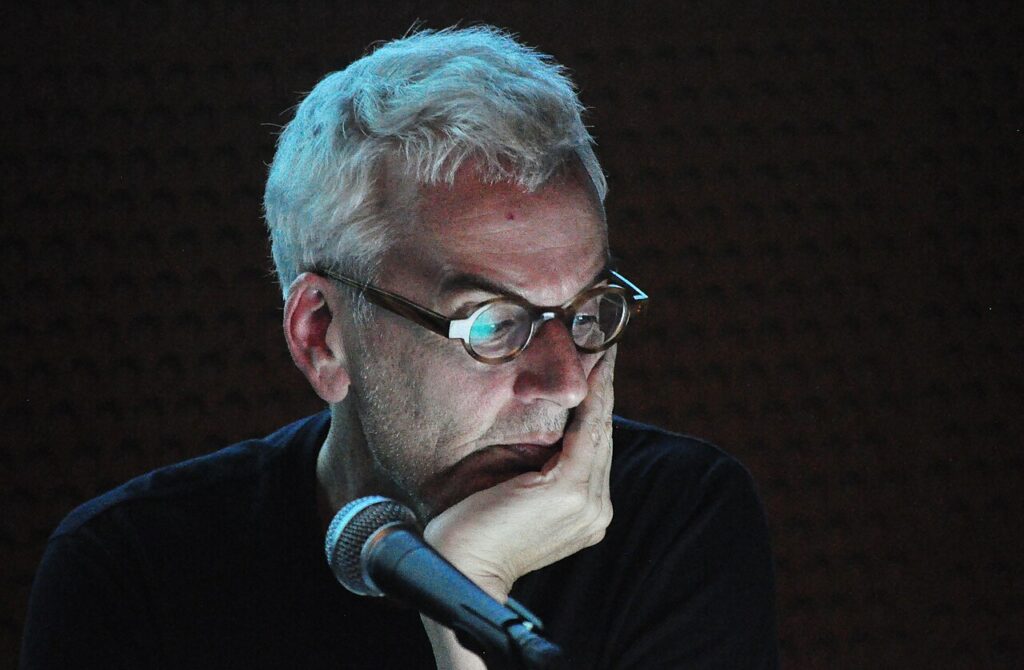
Joshua Clover in 2014. {Photograph} by Joe Mabel. CC BY-SA 3.0, through Wikimedia Commons.
Geoffrey G. O’Brien devoted his poem “Ray of Gentle,” which seems in our latest Fall problem, no. 257, to Joshua Clover, the poet, scholar, and author who handed away final 12 months on the age of sixty-two. Clover’s life and work resisted simple categorization—the Marxist and “physicist of syllables,” as Jorie Graham as soon as referred to as him, wrote for each the tutorial and mainstream press, inflecting his poetry and prose with political critique and social concept, standard music and blockbuster movies. “Once more you sing how / Music and poetry lie / Between joke and reward, concept and gun,” O’Brien writes. “Hoping to be each / Whereas destined to be neither.”
O’Brien is married to the author and Parapraxis founder Hannah Zeavin, who, in an essay for the Day by day final 12 months, recalled a dialog she had with Clover shortly earlier than his demise: “My pal Joshua Clover not too long ago mentioned to me, ‘Everyone knows that the poems worsen after evaluation, Hannah.’ ” Happily, the remit of our collection Making of a Poem is extra anecdotal than analytical, asking poets to carry the hood on a poem they’ve contributed to our pages, and provides us a glimpse of the author and their course of—which, in O’Brien’s case, has a lot to do together with his late pal.
You devoted this poem to Joshua Clover. Are you able to inform us a bit about your relationship with him, and his relationship with this poem?
Joshua was a pal, a pal within the artwork, and a comrade for greater than thirty years, which included a considerable rift within the center that made the eventual friendship’s resumption much more essential. I anticipated many years extra with him. At seven within the morning on April 27, 2025, I bought a name from his associate saying he had died in a single day. He’d been battling a really severe and bafflingly unexplained sickness and was within the hospital, however no person thought he was on the purpose of demise. After all of the work of telling others that morning about this devastating new reality, I sat there shocked, and this poem got here out of me nearly precisely because it now stands. I didn’t intend to write down a poem, and in case you’d requested me if I needed to, I might have mentioned no. However it got here out of primary elegiac intuition to current him in his departure.
How did this poem begin for you? Was it with a picture, an concept, a phrase, or one thing else?
The poem begins with the phrase “Left,” which is doing lots of work, indicating Joshua’s precise passing away, but additionally what he left the world, together with his sensible dream of one other, higher one. “Left” can also be the adjective for a radical politic like Joshua’s, one which refused the current state of issues and testified to that in writing, in school rooms, and within the streets.
The polysemy in that first phrase is my means of attempting to seize all of the issues he was and did, and to have a reader tarry with all its senses—a stance, a bequeathing, a physique that may now not stay on the planet. It’s also my secret communication with him, which he can by no means obtain, and an try to make “Left” keep—it’s the first phrase, not the final.
What had been you listening to / studying / watching when you had been penning this? And had been these issues in any respect inflected by Clover, who, along with his poetry and political writing, wrote typically and severely about music and standard tradition?
Joshua might blast any musical style whereas pursuing any sort of writing. Over many years, I watched him refine his account of music and standard tradition into an beautiful, painful materialist account of why these types do what they do, and what they don’t. See, for instance, 1989: Bob Dylan Didn’t Have This to Sing About and Roadrunner: A Tune by Jonathan Richman and the Trendy Lovers or How I Stop Spin (in about 200 Tweets), the place I occur to characteristic because the pal who was with him on 9/11.
Not like Joshua, I can’t let these sorts of company cultural merchandise in when attempting to compose. I’ve to have “Left the world” a bit to return to it with a poem. However the poem does consult with his first e book of poems, Madonna Anno Domini, and to the e book about Richman’s music, in addition to to the e book he was nonetheless writing at his demise, which we’ll by no means obtain.
The place did you write this poem? Are you able to share images of your workspace, or workspaces?
I wrote it on my mattress, which is just too typically my workspace, perhaps for the explanation I gave above about needing to be away from the world of labor in as some ways as I can, as absolutely as I can.
How did writing the primary draft really feel to you? Did it come simply, or was it troublesome to write down? (Are there onerous and simple poems?)
Simply feels just like the fallacious adverb, nevertheless it got here instantly. Studying it afterward, I’m significantly within the line that retains rearranging its syntax—
Here’s what he taught me:
turns into
Right here taught me what he’s:
then lastly
He taught me what right here is:
—as if I’m combating the willpower of syntactic destiny after I can’t struggle the actual fact of his finish or the “right here” I’ve to face with out him. I additionally suppose he would have appreciated “Items are dangerous elegies” for its conversion of elegy into an expression of the lifeless labor within the commodity and for the false opposition between “items” and “dangerous.”
Along with all the opposite types of his brilliance, he’s the cleverest particular person I’ve ever recognized, in a position to increase that presumably pejorative and cringey mode till it seems like communion and a small mandatory pleasure inside a burning world. I felt in that line like I used to be speaking to him, bantering with him even in his goneness.
What was the problem of this explicit poem?
In a means, the identical as with all poem—how one can finish. However that query of closure—I now hear “Clover” in that phrase—carries a particular sort of weight and issue in elegy, the place you’re ceasing to talk to or of the beloved and immediately are going through the terminal once more within the very artifact that was imagined to reopen or maintain that particular person’s life. The poem’s final line is “Our enemy has no form,” and it hyperlinks us in its first particular person plural, celebrates how essential his thought and artwork had been to describing the shapelessness of capital, and signifies the problem of the work nonetheless to come back. That’s as shut as I might come to stopping with out ending.
I suppose I ought to add this wasn’t technically the top of the poem, since I titled it afterwards, returning to its pre-beginning as if on a hoop street, just like the one Joshua identifies in Jonathan Richman’s music. The title can clearly be metaphorized in some ways, however its loudest sentimentality to me is its serving because the title of a music by Madonna, for whom Joshua had an almost lifelong love.
Unusually, he and my spouse, Hannah Zeavin, had been speaking about this music quite a bit within the weeks earlier than his demise. Joshua advised her that probably the most lovely piece of music criticism in historical past, which now I can’t discover, was a single sentence assessment of that album—“She bought knocked down, however she bought up once more.” To make a poem for this poet and anticapitalist and cultural critic whose title comes from the Queen of Pop was one other type of honoring his manyness—and the excessive, low, and center of the “right here” we shared with commerce and with him.
Geoffrey G. O’Brien is the writer of 5 poetry collections and a professor of English at UC Berkeley.


